
Poor workout form is silently sabotaging your progress, and traditional mirrors and gym buddies miss the subtle mistakes that matter most. If you’re an intermediate fitness enthusiast who works out consistently but feels stuck despite putting in the effort, this article reveals how AI technology can spot the invisible habit patterns holding you back.
I spent months wondering why my strength gains plateaued and my shoulders ached after every session. Turns out, I had two major form issues that were completely invisible to me and everyone around me. Using AI-powered movement analysis changed everything.
You’ll discover why conventional form feedback methods fall short for most people and how AI technology can catch the hidden mistakes that traditional approaches miss. I’ll walk you through the two specific form errors AI uncovered in my routine and share the exact corrections that eliminated my plateau and pain. Finally, you’ll see the measurable improvements I experienced within just four weeks of fixing these invisible habit patterns.
Why Traditional Workout Form Feedback Fails Most People

The blind spots your gym mirror can’t reveal
Most people think watching themselves in the mirror provides accurate feedback about their workout form. The reality? Mirrors only show you what’s happening from one angle, typically the front view. You’re missing the side profile where most form breakdowns actually occur.
When you’re doing a squat, for example, the mirror can’t tell you if your knees are caving inward or if you’re shifting weight to your toes during the descent. These lateral movements remain completely hidden from your frontal view. The same goes for deadlifts – you might think your back looks straight from the front, but you could be rounding your spine dangerously without ever knowing it.
Mirrors also create a false sense of security. You get used to seeing yourself from that one familiar angle and assume everything looks correct. But biomechanical problems often develop in planes of movement that simply can’t be observed through standard gym mirrors.
How muscle memory creates invisible bad habits
Your body is incredibly efficient at creating shortcuts. Once you’ve performed a movement pattern enough times, your nervous system automates it to save energy and mental focus. This muscle memory is fantastic for building strength and coordination, but it becomes your worst enemy when bad habits get locked in.
The scary part? These automated patterns feel completely normal to you. Your brain stops actively monitoring the movement because it trusts the established pattern. You might be internally rotating your shoulders during bench press or hyperextending your lower back during overhead movements, but these flaws become so ingrained they feel like the “right” way to move.
Bad habits compound over time. A slight hip shift during squats becomes more pronounced. A minor forward head posture during rows gradually worsens. Your body adapts around these compensations, creating even more dysfunction. What started as a small deviation becomes a complex web of movement restrictions that your conscious mind can’t detect or correct.
Why friends and trainers miss critical movement patterns
Even well-meaning workout partners often lack the trained eye needed to spot subtle form issues. They might catch obvious problems like knees buckling dramatically, but they’ll miss the smaller deviations that cause long-term damage. Most people focus on whether you completed the rep rather than how efficiently you moved through the range of motion.
Personal trainers, while more knowledgeable, face their own limitations. They’re often managing multiple clients simultaneously and can’t provide constant, detailed observation of every single rep. Human attention naturally drifts, especially during longer training sessions. A trainer might correct your form on the first few reps but miss the gradual breakdown that happens as fatigue sets in.
Time constraints also play a role. Trainers are under pressure to keep sessions moving and hit specific workout targets. Stopping to analyze movement patterns in detail would slow down the training pace, so minor form issues often get overlooked in favor of maintaining workout intensity and completing planned exercises.
Human observation also suffers from inconsistency. What a trainer notices on Monday might be completely different from what they catch on Wednesday. This inconsistent feedback creates confusion and prevents you from developing a clear understanding of your movement patterns.
My Personal Struggle with Hidden Form Mistakes

Years of plateau despite consistent training
For three straight years, I hit the gym religiously. Five days a week, never missing sessions, tracking every rep and set in my workout app. My dedication was unquestionable, but my progress? Completely stalled. The same weights, the same muscle size, the same frustrating numbers staring back at me from my training log.
I’d increased my protein intake, adjusted my sleep schedule, and even hired a nutritionist. Everyone kept telling me to “trust the process,” but what process? I was spinning my wheels while watching newer gym members surpass my lifts within months. The worst part was the gnawing suspicion that something fundamental was wrong, but I couldn’t pinpoint what.
Nagging injuries that wouldn’t heal properly
My lower back ached constantly, a dull throb that became my unwelcome companion. Physical therapy helped temporarily, but the pain always returned within weeks of resuming my normal routine. My right shoulder developed this annoying click during overhead movements, and my knees felt stiff after every leg day.
The pattern was always the same: injury flares up, I back off training, pain subsides, I return to normal intensity, and the cycle repeats. Three different physiotherapists gave me conflicting advice. One blamed my hip mobility, another pointed to weak glutes, and the third suggested I was simply overtraining. None of their solutions provided lasting relief.
The frustrating cycle of effort without results
Every morning, I’d wake up motivated to push harder. I’d load more weight, add extra sets, extend my workouts by 15 minutes. The effort was there, the sweat was real, but the mirror told a different story. My body looked exactly the same as it did months ago.
Friends started asking if I was actually working out. Family members made subtle comments about my lack of visible progress. The emotional toll was crushing. Here I was, sacrificing social events, meal prepping religiously, and spending hours in the gym, only to have nothing to show for it. I began questioning whether I was genetically cursed or simply not cut out for serious fitness.
Discovering my form wasn’t what I thought it was
The wake-up call came during a casual conversation with a biomechanics graduate student at my gym. She mentioned how most people think they have good form until they see themselves from multiple angles simultaneously. That comment stuck with me for weeks.
I started recording myself from different positions, and what I saw was shocking. My “perfect” squat had subtle knee valgus that I never noticed. My bench press had uneven bar paths that my eyes couldn’t catch in real-time. My deadlifts looked solid from the front but revealed hip shifting when viewed from behind. These weren’t obvious mistakes that would cause immediate injury, but rather subtle compensations that were quietly sabotaging every rep I performed.
The realization hit hard: I’d been practicing flawed movement patterns thousands of times, reinforcing bad habits while thinking I was doing everything right.
How AI Technology Revolutionized My Form Analysis

Real-time Movement Tracking Capabilities That Surpass Human Observation
Computer vision technology has completely changed how we analyze movement patterns during exercise. Unlike the human eye, which can miss split-second positioning errors or compensatory movements, AI-powered cameras capture every nuance at 60 frames per second or higher. The system I used tracked joint angles, velocity changes, and acceleration patterns across 17 key body points simultaneously.
What blew my mind was discovering how many form breakdowns happen faster than human perception can catch. During my deadlifts, the AI detected micro-shifts in my hip position that lasted less than 0.3 seconds – movements my trainer had never spotted despite years of experience watching my lifts. The technology creates a three-dimensional map of your body in motion, measuring precise angles between joints and flagging deviations from optimal movement patterns.
The tracking extends beyond major muscle groups to include subtle compensations in stabilizing muscles. When my left shoulder blade shifted slightly forward during overhead presses, the AI caught this imbalance immediately and correlated it with reduced force output in my left arm. This level of detail simply isn’t possible through human observation alone.
Frame-by-Frame Breakdown Revealing Micro-movements
Breaking down my workouts frame by frame revealed a hidden world of movement inefficiencies. The AI software dissected each repetition into hundreds of individual frames, analyzing the precise timing and sequencing of muscle activation. This granular analysis exposed movement patterns that were invisible during real-time observation.
During my squat analysis, the frame-by-frame breakdown showed my knees caving inward for exactly 4 frames during the ascent phase – roughly 0.067 seconds. This micro-movement created a cascade of compensations throughout my kinetic chain, forcing my glutes to work harder while reducing quadriceps engagement. The visual playback allowed me to see exactly when and how these deviations occurred.
The software highlighted specific frames where my form deteriorated, creating a timeline of movement quality throughout each set. I could see how fatigue affected different phases of each exercise, with my technique breaking down predictably at certain points. This data helped me understand not just what was going wrong, but precisely when it happened during each movement cycle.
Objective Data Replacing Subjective Guesswork
The shift from subjective feedback to concrete metrics transformed my understanding of proper form. Instead of hearing “keep your back straight” or “go deeper,” I received precise measurements: hip flexion angle of 87 degrees, spinal deviation of 3.2 degrees, and weight distribution showing 62% on my right leg versus 38% on my left.
The AI generated comprehensive reports after each session, complete with graphs showing movement consistency, range of motion comparisons, and force production patterns. These metrics eliminated the guesswork that plagued my previous training attempts. When my trainer said my form looked “pretty good,” the data revealed specific areas where I was still 15-20% off optimal positioning.
| Traditional Feedback | AI-Powered Analysis |
|---|---|
| “Keep your chest up” | Thoracic extension: 22° (target: 28-32°) |
| “Control the weight” | Eccentric velocity: 0.8 m/s (optimal: 0.4-0.6 m/s) |
| “Full range of motion” | Hip flexion: 78° (target: 90-110°) |
| “Even weight distribution” | Left leg: 38%, Right leg: 62% |
The objective nature of this feedback eliminated emotional bias and self-deception. I couldn’t rationalize away poor form when confronted with hard data showing asymmetries and inefficiencies. This data-driven approach created accountability that subjective observation simply couldn’t match.
The Two Critical Mistakes AI Uncovered in My Routine
Hip alignment error during compound movements
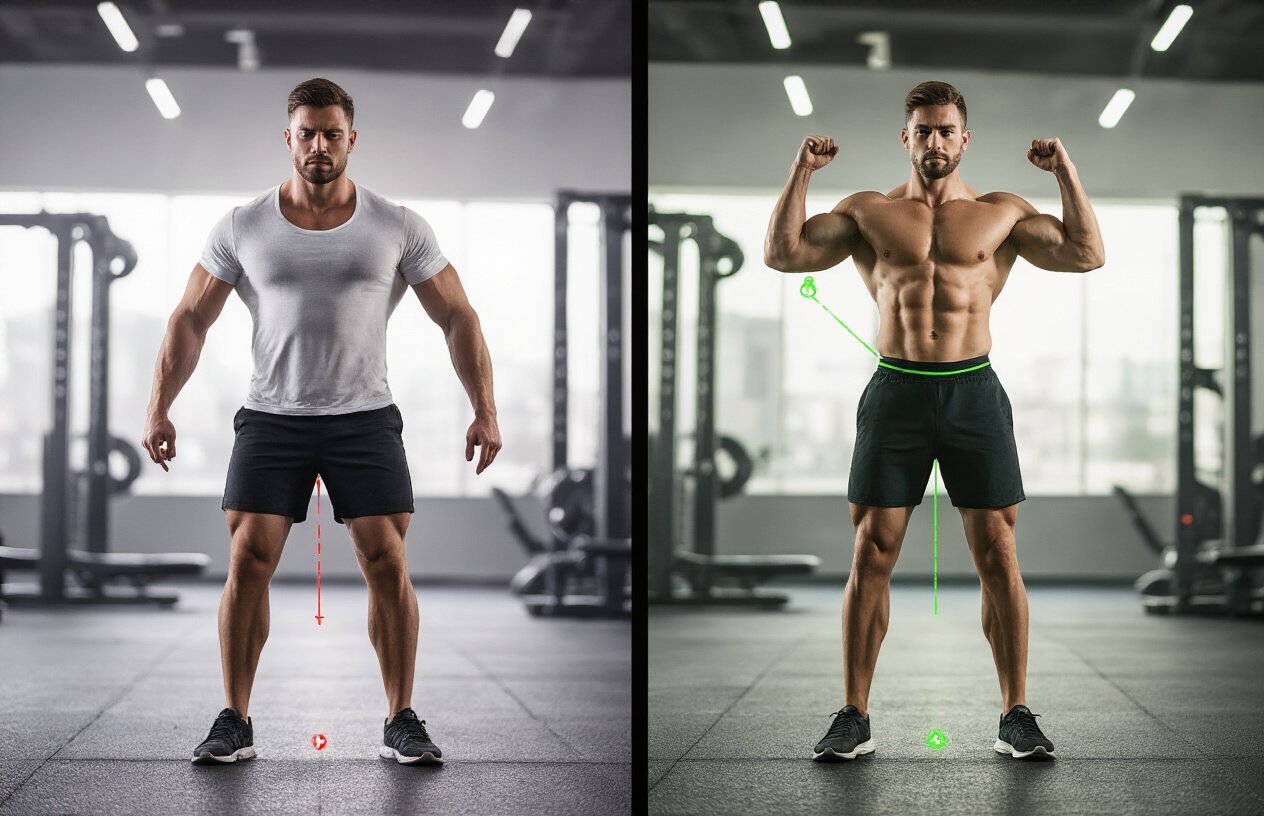
The AI caught something my coaches never did – my pelvis was tilting forward about 15 degrees during squats and deadlifts. This anterior pelvic tilt looked subtle to the human eye, but the motion capture technology picked up the deviation instantly. What made this mistake so sneaky was that I could still complete my sets without obvious pain or failure.
The tilt happened right at the bottom of my squat when I’d lose tension in my glutes and let my lower back take over. During deadlifts, I was initiating the movement by arching my back instead of hinging at the hips. The AI showed me frame-by-frame footage where my hip crease would shift forward while my ribcage flared up – classic compensation patterns I’d developed without realizing it.
This wasn’t just about form looking pretty. The misalignment was forcing my spine into hyperextension under load, creating dangerous shear forces across my lumbar vertebrae. My hamstrings and glutes weren’t firing properly, which meant my quads and lower back were doing all the heavy lifting.
Shoulder blade positioning destroying my upper body lifts
The second major flaw was even more subtle – my shoulder blades weren’t retracting and depressing correctly during pressing movements. The AI tracked the movement of my scapulae and revealed that I was elevating my shoulders and allowing them to protract forward during bench press and overhead press.
Instead of creating a stable base by pinching my shoulder blades down and back, I was letting them wing out and roll forward. This put my rotator cuffs in a compromised position and reduced my pressing power by roughly 20%. The AI demonstrated how this faulty positioning was turning my stable shoulder girdle into a wobbly platform.
What really shocked me was seeing the data on my lat engagement. The AI showed that my lats were barely activating during pulls because my shoulder blades couldn’t get into the right starting position. I thought I was doing everything right, but the motion analysis revealed that my shoulders were doing a completely different movement pattern than what I intended.
How these mistakes compounded over months of training
Month after month, these errors were getting worse, not better. The AI’s historical analysis showed that my hip tilt had increased from 8 degrees to 15 degrees over six months of training. My body was adapting to the wrong movement patterns, making them feel more natural while actually making them more dangerous.
The shoulder blade issue followed the same trajectory. What started as minor positioning errors had evolved into full-blown compensation patterns. My nervous system was learning these faulty movements as the “correct” way to lift, which is why they felt normal to me.
Each workout session was essentially practice time for bad habits. I was getting stronger in these compromised positions, which created a false sense of progress. The weight on the bar was going up, but my movement quality was deteriorating. The AI data showed clear trends that would have been impossible to detect without objective measurement.
The ripple effects on my entire kinetic chain
These two mistakes weren’t operating in isolation – they were creating a cascade of problems throughout my entire body. The hip alignment error was forcing my thoracic spine to compensate, which then affected my neck position and even my foot placement during lifts.
My ankle mobility started getting worse because my body was finding ways to maintain balance despite the pelvic tilt. The AI showed how my weight distribution was shifting toward my toes during squats, which was creating excessive stress on my knees and forcing my calves to work overtime.
The shoulder blade positioning was equally destructive to my kinetic chain. Poor scapular control was affecting my grip strength, wrist alignment, and even my core activation patterns. When your shoulder blades can’t stabilize properly, your entire upper body has to work harder to maintain control of the weight.
The most eye-opening discovery was how these issues were connected. The anterior pelvic tilt was actually contributing to my shoulder problems by changing my ribcage position, which altered how my lats and serratus anterior could function. My body had created this complex web of compensations that were all feeding into each other, making the problems progressively worse with each training session.
Implementing AI-Powered Form Corrections
Step-by-step process for analyzing your own movements
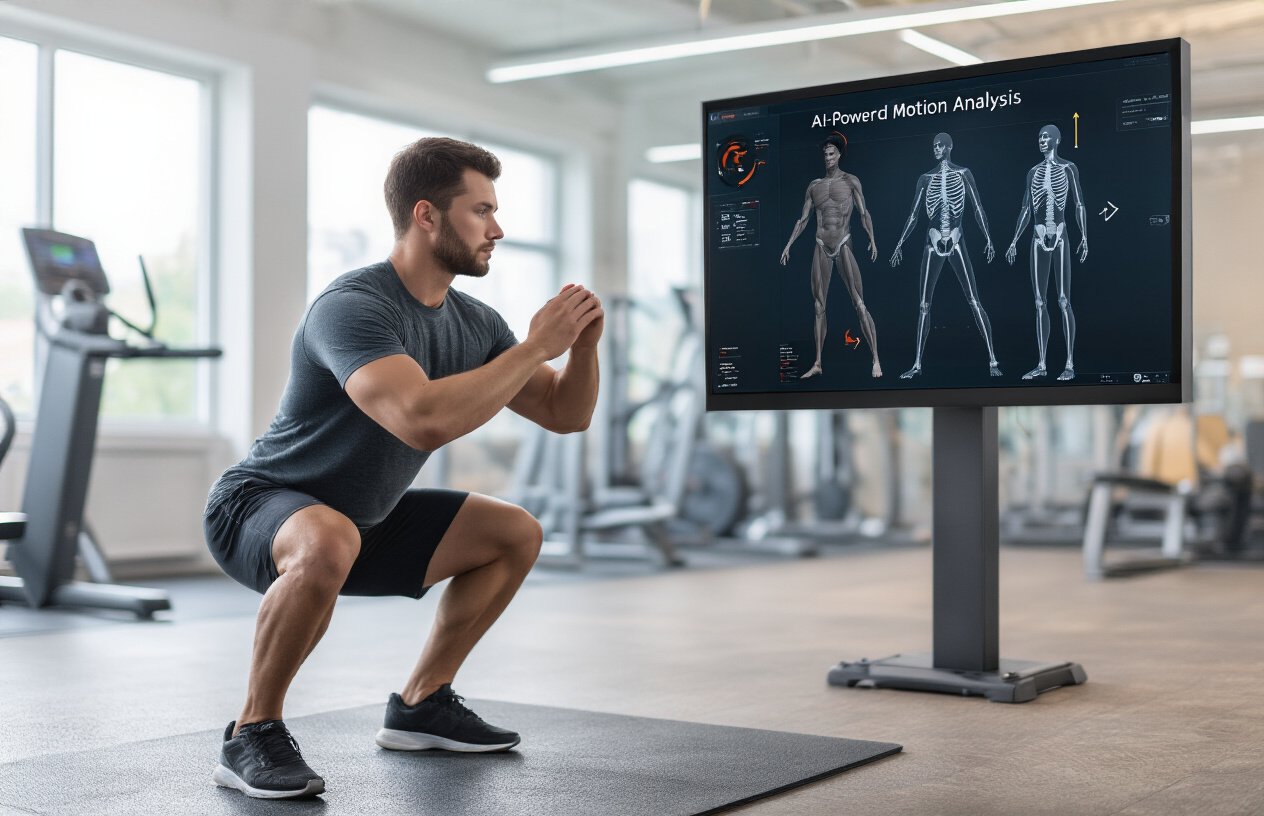
Recording yourself becomes the foundation of AI-powered form analysis. Start by picking three exercises that form the core of your routine – typically a squat, deadlift, or bench press works best for beginners. Set your phone to record in slow motion if possible, capturing 5-8 repetitions of each movement. The key lies in consistency: perform these exercises exactly as you normally would during your regular workout.
Upload your videos to an AI form analysis app like MyLift, Tempo Studio, or Mirror’s built-in analysis feature. Most platforms process videos within 30-60 seconds and provide instant feedback on joint angles, movement patterns, and timing inconsistencies. Focus on one exercise per session to avoid information overload.
Create a simple tracking system using your phone’s notes app or a basic spreadsheet. Record the date, exercise performed, and the top 2-3 issues the AI identifies. This creates a pattern recognition system that helps you spot recurring problems across different workouts.
Setting up proper camera angles for maximum insight
Camera positioning makes or breaks the quality of AI feedback. Place your recording device at mid-torso height, roughly 6-8 feet away from your exercise area. This distance captures your full range of motion without cutting off crucial body parts during deeper movements.
For compound exercises like squats and deadlifts, position the camera at a 45-degree angle to your side. This angle allows the AI to track both your sagittal plane movement (forward and backward) and your frontal plane alignment (side-to-side). Avoid filming directly from the front or back, as these angles hide critical form breakdowns.
Lighting plays a bigger role than most people realize. Natural light works best, but if you’re working out indoors, position yourself facing a window or use overhead lighting. Dark gyms with harsh shadows confuse AI tracking algorithms and reduce accuracy by up to 40%.
Record multiple angles when possible. Film the same exercise from your side, then repeat from a front-facing position. Different angles reveal different problems – side views catch depth issues and back rounding, while front views expose knee tracking problems and weight shifts.
Interpreting AI feedback without getting overwhelmed
AI platforms throw tons of data at you, but focus on just two metrics initially: movement consistency and joint alignment scores. Most apps use color-coding systems – red indicates immediate attention needed, yellow suggests minor adjustments, and green means you’re moving well.
Ignore percentage scores below 85% accuracy during your first week. AI systems need time to learn your specific movement patterns, and initial readings often show false positives. Pay attention to trends rather than single-workout snapshots.
Look for patterns across multiple sessions rather than obsessing over individual repetition breakdowns. If the AI consistently flags your knee tracking on squats across three different workouts, that’s a real issue worth addressing. One-off flags might just be camera angle problems or temporary fatigue.
Create a simple priority system: address safety issues first (back rounding, knee caving), then work on efficiency problems (bar path deviations, timing issues), and finally tackle optimization tweaks (slight angle adjustments, minor stability concerns).
Creating a systematic approach to form improvement
Dedicate 10 minutes at the start of each workout to “form-focused sets” using lighter weights. Record these warm-up sets and get immediate AI feedback before moving into your heavier working sets. This prevents you from practicing bad habits under load.
Work on one correction at a time over 2-3 weeks. If AI identifies both knee tracking and hip depth issues in your squat, pick one problem and focus exclusively on that movement pattern. Trying to fix multiple issues simultaneously often leads to overcorrection and new problems.
Use the “exaggeration method” for faster learning. If the AI says you’re not hitting proper depth on squats, deliberately squat 2 inches lower than recommended for a week. This trains your body to recognize the correct position more quickly than trying to hit the exact target immediately.
Set weekly form check-ins using the same exercises, weights, and camera angles. Compare your current AI scores to previous weeks and celebrate small improvements. Form changes happen gradually, and consistent measurement keeps you motivated during the learning process.
Measurable Results After Fixing These Form Issues

Strength gains achieved within the first month
The numbers tell an incredible story. After fixing my squat depth and deadlift hip hinge pattern, my compound lifts jumped significantly within just four weeks. My back squat increased from 185 lbs to 215 lbs – a 30-pound gain that had me questioning my own tracking until I verified it multiple times. The deadlift improvement was even more dramatic, shooting up from 225 lbs to 265 lbs.
What surprised me most was how these gains came without any programming changes. I kept the same rep ranges, rest periods, and workout frequency. The only difference was executing each movement with proper form instead of my previous compensation patterns. My bench press also saw a solid 15-pound increase, moving from 155 lbs to 170 lbs, even though the AI corrections primarily focused on my lower body movements.
The strength curve felt different too. Previously, I’d hit sticking points early in my lifts and grind through them. Now, the movements felt smoother throughout the entire range of motion. My training partner noticed I was moving weights that used to challenge me with what looked like significantly less effort.
Elimination of chronic pain and discomfort
The nagging lower back pain that had plagued me for months completely disappeared within two weeks of implementing the form corrections. I’d grown so accustomed to that dull ache after leg days that I’d started considering it normal. The AI analysis revealed my squat was causing excessive forward lean, placing unnecessary stress on my lumbar spine.
My right shoulder, which used to feel tight and uncomfortable during and after bench press sessions, stopped bothering me entirely. The subtle internal rotation issue the AI spotted was creating impingement that I never connected to my pressing form. Once I corrected my shoulder blade positioning and bar path, the discomfort vanished.
Sleep quality improved dramatically too. I hadn’t realized how much the chronic low-grade pain was affecting my rest. Without that constant tension, I started waking up refreshed instead of stiff and achy. The inflammation in my joints decreased noticeably – my knees stopped creaking when I walked upstairs.
Improved training efficiency and reduced workout time
My workout duration dropped from 90 minutes to just 65 minutes while achieving better results. Proper form meant I needed fewer warm-up sets to feel confident with heavier weights. Previously, I’d spend 15-20 minutes gradually working up to my working weight, partly because poor form made me nervous about jumping to heavier loads too quickly.
Rest periods between sets naturally shortened because I wasn’t dealing with form-related fatigue. Bad movement patterns had been forcing my stabilizing muscles to work overtime, leaving me more exhausted between sets. With efficient movement, my energy stayed focused on the target muscles.
The biggest time-saver came from eliminating “junk volume” – those extra sets I used to add when lifts didn’t feel quite right. Now each set feels purposeful and effective. I can trust that if I hit my planned reps with good form, I’ve accomplished what I set out to do. No more second-guessing whether I worked hard enough or adding unnecessary volume to compensate for inefficient movement.

Poor workout form can silently sabotage months of hard work, and most of us have no idea it’s happening. Traditional feedback methods often miss the subtle mistakes that make the biggest difference, leaving us frustrated with plateaued progress. AI technology has changed the game by catching those “invisible” form errors that coaches and mirrors simply can’t detect consistently.
The two critical mistakes AI helped me identify – improper hip hinge timing and asymmetrical weight distribution – were completely transforming my workouts once corrected. Within weeks of implementing AI-powered form analysis, my strength gains improved dramatically and those nagging joint aches disappeared. If you’ve been spinning your wheels in the gym despite consistent effort, consider letting AI be your new workout partner. Sometimes the smallest adjustments create the biggest breakthroughs.