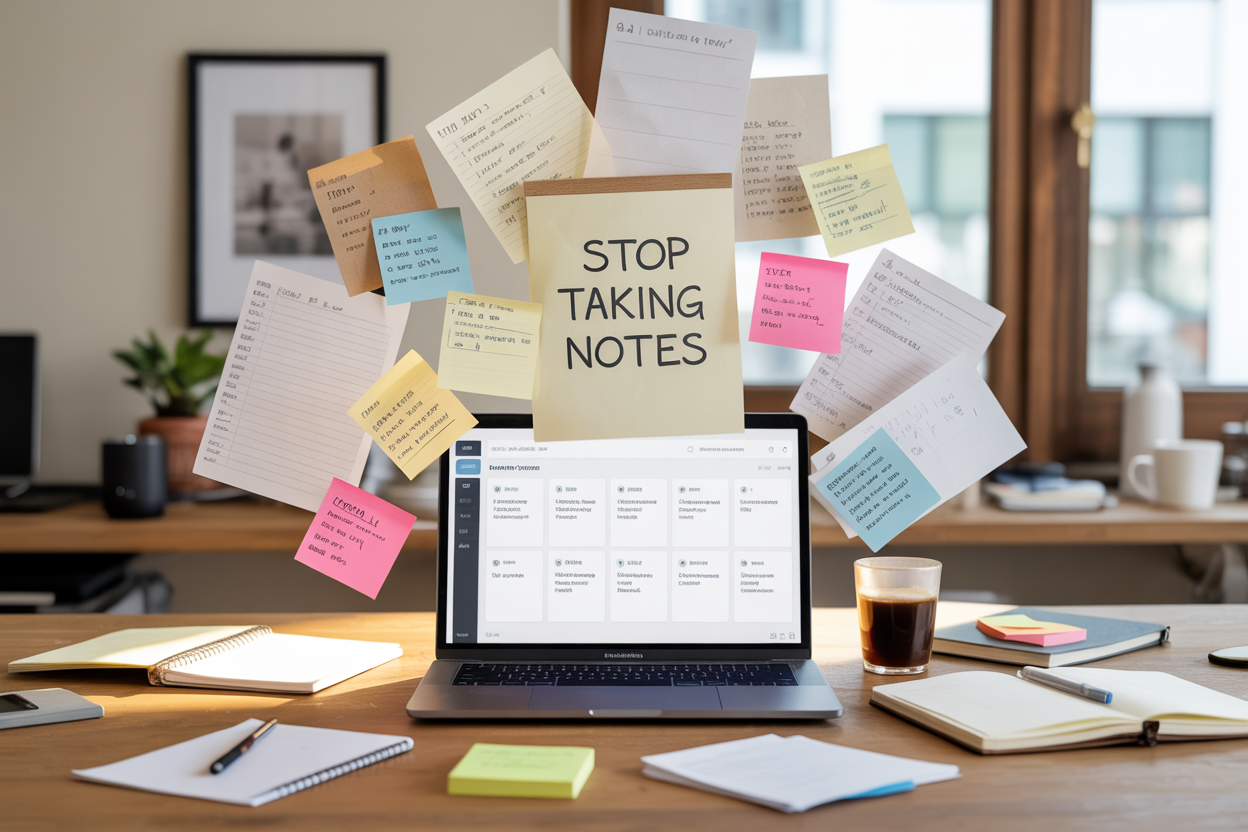
Your brain dumps everything onto digital pages, but those scattered thoughts turn into digital clutter that’s impossible to navigate later. You’re drowning in fragmented ideas, random insights, and half-formed concepts that could be brilliant—if only you could find them again.
This guide is for busy professionals, creative thinkers, and productivity enthusiasts who love brain dumping but hate the messy aftermath. You’ll discover how Notion AI can instantly transform your mental chaos into organized, searchable knowledge systems without the tedious work of traditional note-taking.
We’ll explore why your current brain dump method is working against your creative flow and show you how to set up an effortless system that automatically organizes your thoughts. You’ll also learn advanced AI tricks that turn your scattered mental downloads into actionable insights, giving you a productivity superpower that actually works with your brain instead of against it.
Why Traditional Note-Taking Fails Your Creative Brain

The Overwhelming Chaos of Scattered Thoughts Across Multiple Platforms
Your brilliant ideas don’t follow a schedule. They pop up during your morning shower, strike while you’re walking the dog, or hit you mid-conversation with a colleague. So naturally, you capture them wherever you can – sticky notes on your monitor, voice memos on your phone, random documents on your desktop, notebook margins, and that one app you swore would solve everything.
Sound familiar? This scattered approach creates a nightmare of digital and physical chaos. Your breakthrough idea from last Tuesday? Buried somewhere in a sea of half-finished thoughts across seven different platforms. The connection you made between two projects? Lost in a folder you can’t remember naming.
This fragmentation doesn’t just make finding things difficult – it actively works against your brain’s natural networking abilities. When ideas live in isolation across different systems, your mind can’t easily spot patterns or build on previous thoughts. You end up reinventing the wheel because you’ve forgotten you already solved a similar problem three months ago.
How Linear Note-Taking Kills Spontaneous Idea Connections
Traditional note-taking forces your dynamic, interconnected thoughts into rigid, sequential formats. You write idea A, then idea B, then idea C, as if creativity follows a straight line. But your brain doesn’t work that way – it jumps, loops back, and makes unexpected connections between seemingly unrelated concepts.
Linear systems like traditional notebooks or basic text documents trap your ideas in chronological prison cells. That marketing insight from March has no natural way to link with the product development breakthrough from August, even though they could spark something amazing together.
Your creative brain thrives on associations, tangents, and sudden “what if” moments. When you force these fluid thoughts into straight-line structures, you’re essentially asking a jazz musician to play only scales. The magic happens in the improvisation, the unexpected turns, the moments when one idea triggers another seemingly unrelated thought that becomes your next big breakthrough.
The Mental Energy Drain of Constantly Organizing While Thinking
Here’s the productivity killer nobody talks about: the cognitive load of organizing while you’re trying to think. Traditional note-taking demands that you become both creator and curator simultaneously. You’re trying to capture a fleeting insight while simultaneously deciding which folder it belongs in, what category it fits, and how to format it properly.
This dual-tasking creates mental friction that slows down your thinking process. Instead of following your creative momentum, you’re constantly interrupted by organizational decisions. Should this go in the “Projects” folder or “Random Ideas”? What tags should you add? How should you title this note so you’ll find it later?
Your brain has limited processing power, and every organizational decision you make while thinking steals energy from the actual creative work. You end up with perfectly categorized mediocre ideas instead of messily captured brilliant ones.
Why Your Best Insights Get Lost in Messy Documentation
The cruel irony of traditional note-taking is that your most valuable insights often get buried under poor documentation habits. When inspiration strikes, you’re focused on capturing the idea, not creating a searchable, well-formatted note. So you jot down cryptic phrases like “customer thing + automation = goldmine” and assume you’ll remember what that meant.
Three weeks later, you’re staring at your own handwriting like it’s ancient hieroglyphics. The context that made perfect sense in the moment has evaporated, leaving behind fragments that could have been breakthrough material.
Even worse, the pressure to document things “properly” often kills ideas before they’re fully formed. You start second-guessing whether an insight is worth writing down, or you delay capturing it while you think about how to articulate it clearly. By the time you’re ready to write, the moment has passed and the idea has slipped away.
Your messy brain dumps contain gold mines of potential, but traditional systems make that gold impossible to extract and refine. The solution isn’t better organization skills – it’s a system that can handle the beautiful chaos of how creative minds actually work.
The Brain Dump Revolution: Unleashing Your Mental Downloads

Understanding how your brain naturally processes information
Your brain doesn’t think in organized bullet points or neat categories. It operates more like a jazz musician improvising – jumping between ideas, making unexpected connections, and building on scattered thoughts that seem unrelated at first glance. This messy, nonlinear approach is exactly what makes human thinking so powerful.
When you’re processing information, your brain creates neural pathways that connect new concepts to existing knowledge. These connections happen rapidly and often subconsciously, which is why breakthrough ideas often emerge during mundane activities like showering or walking. The problem with traditional note-taking is that it forces you to slow down and organize thoughts the moment they appear, interrupting this natural flow.
Research in cognitive psychology shows that our working memory can only hold about 7 pieces of information at once. When you try to capture and organize simultaneously, you’re essentially asking your brain to juggle two complex tasks, reducing the quality of both. Your creative mind works best when it can dump everything first, then sort through the pieces later.
The psychology behind effective thought capture
Effective thought capture works with your brain’s natural rhythms, not against them. The key lies in understanding the difference between generative thinking and evaluative thinking – two distinct cognitive processes that shouldn’t happen simultaneously.
During generative thinking, your brain is in exploration mode. Ideas flow freely, building momentum as one thought triggers another. This is when breakthrough insights happen. Evaluative thinking, on the other hand, involves judgment, categorization, and refinement. Both are crucial, but mixing them creates cognitive friction.
The most productive thinkers separate these phases completely. They capture first, organize later. This approach reduces cognitive load and prevents the inner critic from shutting down creative flow. Studies show that people who use unstructured capture methods generate 40% more original ideas compared to those who organize while thinking.
Your brain also has a tendency to forget details within 20 seconds unless they’re actively rehearsed or written down. This creates pressure to organize immediately, but that pressure actually hinders the very creativity you’re trying to capture. Brain dumping removes this pressure entirely.
Why messy brain dumps actually boost creativity
Messy brain dumps aren’t just acceptable – they’re scientifically superior for creative thinking. When you allow thoughts to spill out chaotically, you’re mimicking your brain’s natural associative processes. This creates space for unexpected connections that wouldn’t emerge through structured thinking.
Creative breakthroughs rarely follow logical progressions. They emerge from the intersection of seemingly unrelated ideas. A messy brain dump captures these random intersections, preserving the raw material that structured thinking might filter out as irrelevant.
The visual chaos of an unorganized brain dump also triggers different cognitive processes. Your brain starts pattern-matching automatically, looking for themes and connections across the scattered thoughts. This passive organization happens in the background while you continue generating new ideas.
Professional writers, designers, and innovators have long understood this principle. They fill notebooks with seemingly random observations, knowing that patterns will emerge later. The mess isn’t a bug – it’s a feature that preserves the full spectrum of your thinking, including the “irrelevant” details that might spark your next big idea.
When you combine this natural creative process with AI’s organizational capabilities, you get the best of both worlds: unrestricted creative flow during capture, followed by instant, intelligent organization that reveals hidden patterns in your thinking.
Notion AI’s Game-Changing Organization Powers

How AI instantly categorizes your random thoughts
When you dump a stream-of-consciousness paragraph into Notion, the AI doesn’t just sit there waiting for instructions. It actively scans your text and identifies patterns, themes, and categories that your brain naturally created but couldn’t organize in the moment. The system recognizes when you’re talking about work projects versus personal goals, creative ideas versus actionable tasks.
Picture this: you write “Need to call mom about dinner plans, finish the Q3 report by Friday, maybe try that new painting technique with watercolors, and remind Sarah about the budget meeting.” Notion AI instantly sees four distinct categories here – personal tasks, work deadlines, creative pursuits, and team communication. Without you lifting a finger, it can sort these into appropriate databases or tag them accordingly.
The magic happens through natural language processing that understands context clues. Words like “deadline,” “meeting,” and “report” signal work content, while “mom,” “dinner,” and personal pronouns indicate personal items. The AI becomes smarter with each brain dump, learning your specific vocabulary and thought patterns.
The automatic tagging system that thinks like you do
Notion AI doesn’t just slap generic labels on your content. It creates personalized tag systems that mirror how your brain actually works. After analyzing your writing patterns, it starts suggesting tags that feel intuitive because they’re based on your own mental frameworks.
The system observes which words you frequently use together and builds tag hierarchies around those connections. If you often mention “client projects” alongside specific company names, the AI learns to create nested tags like #Work > #Clients > #CompanyName. These aren’t predetermined categories – they emerge organically from your own thinking style.
What makes this revolutionary is the predictive element. As you start typing a new brain dump, Notion AI begins suggesting relevant tags before you finish writing. It recognizes incomplete thoughts and contextual hints, offering tag suggestions that often capture exactly what you were thinking before you’ve fully articulated it.
Smart connections that link related ideas across projects
The real power emerges when Notion AI starts connecting dots between seemingly unrelated entries. Maybe you mentioned a marketing strategy three weeks ago and just wrote about a client conversation today. The AI identifies the underlying relationship and suggests linking these pieces together.
These connections work across different databases, pages, and even deleted content that left traces in your workspace. When you write about “improving team communication,” the AI might surface that framework you created months ago for project management, or link to notes from a relevant book you read.
The system builds a knowledge graph of your thoughts, creating a web of relationships that mirrors how memory actually works. Instead of linear filing systems, you get organic networks where one idea naturally leads to related concepts, just like your brain intended.
Real-time content structuring without manual effort
Watch your messy paragraphs transform into organized content as you write. Notion AI recognizes when you’re listing items and automatically converts them into proper bullet points or numbered lists. When it detects you’re comparing options, it can suggest table formats. Long rambling thoughts get broken into digestible sections with suggested headings.
The restructuring happens in the background without interrupting your flow. You keep dumping thoughts naturally while the AI quietly identifies structure patterns – introductory statements, supporting details, action items, and conclusions. Once you pause, it offers formatting suggestions that turn your stream of consciousness into readable, actionable content.
This real-time organization means you never lose momentum switching between creative thinking and systematic organizing. Your brain stays in generative mode while the AI handles the tedious work of making everything presentable and usable later.
Setting Up Your Effortless Brain Dump System

Creating the perfect Notion template for instant capture
Your brain dump system needs one thing above all else: speed. When brilliant ideas strike, you can’t afford to fumble around with complex formatting or hunt for the right page. Start by creating a master template that captures everything without friction.
Design your template with three core components: a quick-entry section at the top, automatic timestamping, and flexible categorization tags. The quick-entry area should be a simple text box where you dump everything—thoughts, meeting notes, random insights, task ideas. Think of it as your mental parking lot where nothing gets lost.
Add properties that work for your brain. Most people benefit from a simple tagging system: #ideas, #tasks, #projects, #random. Don’t overcomplicate this part. Your AI will handle the heavy lifting later. Include a priority dropdown (High, Medium, Low, None) and a status tracker (New, Processing, Done).
The magic happens when you set up automatic templates for different entry types. Create keyboard shortcuts that instantly spawn the right format—meeting notes, project brainstorms, daily thoughts. Your template should feel invisible, like writing on a napkin but with superpowers.
Configuring AI prompts that understand your thinking style
Generic AI prompts produce generic results. The secret lies in training Notion’s AI to understand how your mind works. Start by analyzing your natural thinking patterns. Do you think in bullet points or long paragraphs? Are you detail-oriented or big-picture focused? Do you jump between topics or follow linear thought processes?
Create custom prompt templates that mirror your style. Here’s what works for different thinking types:
| Thinking Style | Optimal AI Prompt Structure |
|---|---|
| Stream-of-consciousness | “Organize this brain dump into themes and extract actionable items” |
| Detail-heavy | “Summarize key points and identify missing information or next steps” |
| Visual thinker | “Convert these ideas into a structured outline with clear relationships” |
| Task-oriented | “Extract all action items and categorize by priority and timeline” |
Train your AI with examples of your best organized thoughts. When it produces results you love, save those prompts. Build a library of go-to commands like “Make this meeting note actionable,” “Find the key insights here,” or “Turn this brainstorm into a project plan.”
The real breakthrough comes from prompt chaining—where one AI action triggers the next. Set up sequences that automatically clean up your writing, extract tasks, suggest related projects, and even schedule follow-ups.
Building automated workflows that organize while you think
Automation turns your brain dump from a messy pile into a self-organizing system. The goal is creating workflows that run in the background while you focus on thinking and creating.
Start with trigger-based organization. When you tag something as #meeting, your workflow should automatically move it to your meetings database, extract attendees from the text, and create follow-up reminders. Tag something as #idea and watch it flow to your innovation pipeline with automatic priority scoring based on keywords.
Build smart filtering systems using Notion’s formula properties. Create views that surface urgent items, group related thoughts, and highlight patterns you might miss. Your “Today’s Focus” view should automatically pull high-priority items, recent ideas, and overdue tasks without any manual curation.
Set up recurring automation that keeps your system clean. Weekly reviews become effortless when AI pre-sorts everything into “Completed,” “Still Relevant,” and “Needs Action” buckets. Monthly archives automatically move old content while preserving searchability.
The most powerful workflow connects your brain dumps to your broader productivity system. When AI identifies a task in your notes, it should automatically check your calendar for scheduling opportunities, cross-reference similar projects, and suggest relevant resources from your knowledge base. Your thoughts become immediately actionable without additional mental overhead.
Create feedback loops that improve your system over time. Track which prompts produce the best results, which tags you actually use, and which automated actions save the most time. Your brain dump system should evolve with your thinking patterns, becoming more intuitive and powerful with every use.
Advanced AI Tricks That Transform Mental Chaos Into Clarity

Maximizing Your New Superpower for Peak Productivity

Integrating brain dumps into your daily workflow
The secret to maximizing your brain dump superpower lies in making it as automatic as breathing. Start by identifying your peak mental energy windows – those moments when ideas flow freely but disappear just as quickly. For most people, this happens during morning coffee, evening wind-down, or those random shower thoughts.
Create brain dump triggers throughout your day. Set a gentle phone reminder for 10 AM, 3 PM, and before bed. These aren’t rigid schedules but gentle nudges to pause and capture what’s swirling in your mind. The beauty of Notion AI is that you can dump everything messily and let the AI sort it later.
Transform dead time into brain dump gold mines. Waiting for meetings to start? Open Notion and let your thoughts flow. Stuck in traffic (as a passenger)? Voice-to-text your mental downloads directly into your system. The key is removing friction – the easier it is to capture thoughts, the more you’ll actually do it.
Build a simple daily routine: morning brain dump for the day ahead, midday capture for random insights, and evening reflection for processing what happened. This rhythm creates a natural flow where your mind starts anticipating these release valves, making you more mentally agile throughout the day.
Leveraging organized thoughts for faster decision-making
Once Notion AI organizes your chaotic thoughts into clean categories, decision-making becomes lightning-fast. Instead of rehashing the same mental loops, you have a clear reference point of your actual thinking patterns and priorities.
Create decision matrices from your organized brain dumps. When AI categorizes your thoughts about a project, you’ll see patterns emerge – what excites you, what drains you, what you keep avoiding. This insight dramatically speeds up choices because you’re working with processed intelligence rather than raw mental noise.
Use your organized thoughts as a personal advisory board. Before making decisions, scan through your categorized insights on similar topics. You’ll often find that past-you already worked through similar challenges and left breadcrumbs for future decisions.
The real magic happens when you spot recurring themes. Maybe your AI-organized dumps consistently highlight the same concerns about work-life balance, or the same excitement about creative projects. These patterns become your internal compass, making decisions feel obvious rather than agonizing.
Turning captured ideas into executable project plans
The gap between brilliant ideas and actual execution disappears when you have AI-organized brain dumps as your foundation. Your messy thoughts become the raw material for structured action plans.
Start by letting AI group related ideas across different dump sessions. That random thought about learning Spanish from three weeks ago connects beautifully with your recent musings about travel and personal growth. Suddenly, you have a project cluster ready for development.
Transform idea clusters into project templates:
- Vision: What the organized thoughts reveal about your deeper motivation
- Components: Breaking down the AI-categorized elements into actionable chunks
- Quick wins: Identifying the easiest first steps from your thought collection
- Resources: Noting tools, people, or information mentioned in your dumps
The power comes from working with your actual thought patterns rather than forcing artificial project structures. When you build plans from your genuine mental downloads, execution feels natural because you’re following your brain’s authentic connections rather than someone else’s framework.
Your brain dumps become a project pipeline. Regular mental downloads create a constant stream of potential initiatives, and AI organization helps you spot which ideas have enough substance to warrant development. This approach eliminates the dreaded “what should I work on next?” paralysis because your organized thoughts reveal your true priorities.

Your scattered thoughts don’t need to stay scattered anymore. Notion AI has completely changed the game by turning your messy brain dumps into organized, actionable information without you lifting a finger. The days of wrestling with traditional note-taking methods that stifle your creativity are over. Now you can dump everything from your mind and let AI do the heavy lifting of sorting, categorizing, and making sense of it all.
The system you’ve just learned about isn’t just another productivity hack – it’s a fundamental shift in how you capture and organize your thoughts. Your brain works best when it can flow freely without worrying about structure or format. Set up your brain dump system today and watch as your mental chaos transforms into clear, organized insights that actually move your projects forward. Your future self will thank you for making this simple but powerful change.