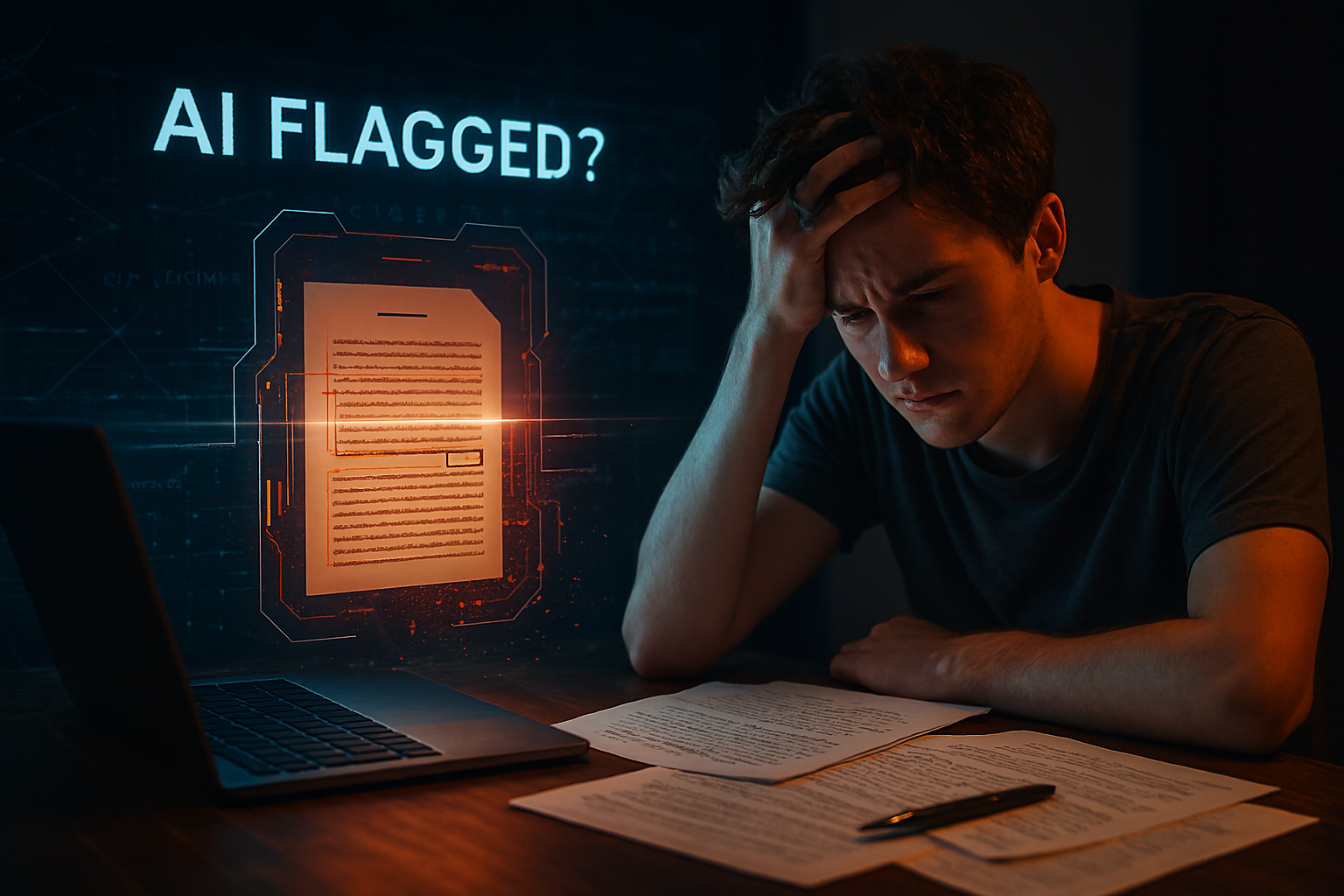
Imagine the feeling: you pour hours of effort into an essay, carefully crafting each argument and sentence. You submit it, proud of your work, only to receive a notification that it has been flagged as 100% AI-generated. The stress and frustration are immediate. Your integrity is questioned not by a person, but by an algorithm.
This scenario is becoming increasingly common for students and writers in the age of generative AI. While AI detection tools are designed to uphold academic and professional standards, they are not infallible. These systems can and do make mistakes, leading to false positives that penalize authentic, human effort.
Fortunately, a false accusation doesn’t have to be the final word. If you find yourself in this situation, there are practical, actionable strategies you can use to prove your authorship and defend your work. Here are five powerful ways to authenticate your human-written content.
When an algorithm makes a mistake, you can fight back with evidence of your very human process. These five strategies will help you build a compelling case.
1. Showcase Your Process with Version History
Modern writing platforms like Google Docs and Microsoft Word are your allies. They automatically track the entire, often messy, journey of your document’s creation. This version history is a digital breadcrumb trail of your intellectual labor, showing every edit, deletion, typo, and break you took along the way.
Counter-intuitively, perfection is suspicious. An AI can generate a polished draft instantly, but it cannot replicate the non-linear, iterative process of human writing. Presenting this history—complete with its mistakes and revisions—demonstrates a workflow that is uniquely human.
A linear, perfect draft from start to finish is a red flag for many educators, but a messy, evolving draft is strong evidence of human work.
2. Use Your Analog Brainstorms and Drafts
In a digital-first world, old-school methods can be your strongest defense. Physical evidence is incredibly difficult to dispute. If you brainstormed ideas in a notebook, sketched an outline on paper, or jotted down handwritten notes, these artifacts are tangible proof of your engagement with the topic. This evidence is powerful because it exists entirely outside the digital ecosystem where AI operates. An algorithm can’t generate a coffee-stained notebook, making it a uniquely human and irrefutable artifact of your intellectual journey.
3. Be Ready to Explain Your Thought Process
An AI can generate text, but it cannot articulate the reasoning behind its choices in the same way you can. Offer to verbally defend your work. Be prepared to explain why you structured your argument a certain way, how you came to your conclusions, and even why you chose specific words or phrases. This demonstrates a deep, personal understanding of the content that an AI lacks. For an even more definitive proof, you can offer to participate in a supervised, live writing session to demonstrate your writing ability and subject matter knowledge in real-time.
4. Weave in Unique Personal Experiences
AI models are trained on vast amounts of publicly available internet data. Their knowledge is extensive but limited to what has already been published. This creates an opportunity to make your work fundamentally human. By incorporating unique personal anecdotes, niche information from your own life, or specific reflections that aren’t widely published online, you create content that an AI cannot authentically replicate. This personal touch provides a clear signal of human authorship because AI lacks genuine consciousness and lived experience; it can only simulate stories based on data, not create them from authentic memory.
5. Get a Second Opinion from a Different AI Detector
No AI detection tool is perfect, and different models can produce wildly different results. If your work has been flagged by one tool, run it through another reputable AI detector. If the second tool yields a different result—for example, flagging the work as human-written—it introduces reasonable doubt about the accuracy of the initial accusation. Conflicting results weaken the certainty of the claim against you and strengthen your case for a manual, human review by an educator or editor.
Conclusion: The Burden of Proof in the Age of AI
Being falsely accused by an algorithm is a disempowering experience, but you are not helpless. By leveraging version histories, physical notes, verbal explanations, personal experience, and secondary AI tools, you have several powerful methods to defend your authentic work.
It is also vital to remember that you can respectfully question the technology itself. Experts and even the companies that build these tools openly acknowledge their fallibility and potential for false positives. In the end, an algorithmic judgment is not an irrefutable fact; it is an output that deserves scrutiny, forcing us to ask a critical question: as these tools become more common, who should ultimately bear the burden of proof—the writer, or the algorithm that accuses them?