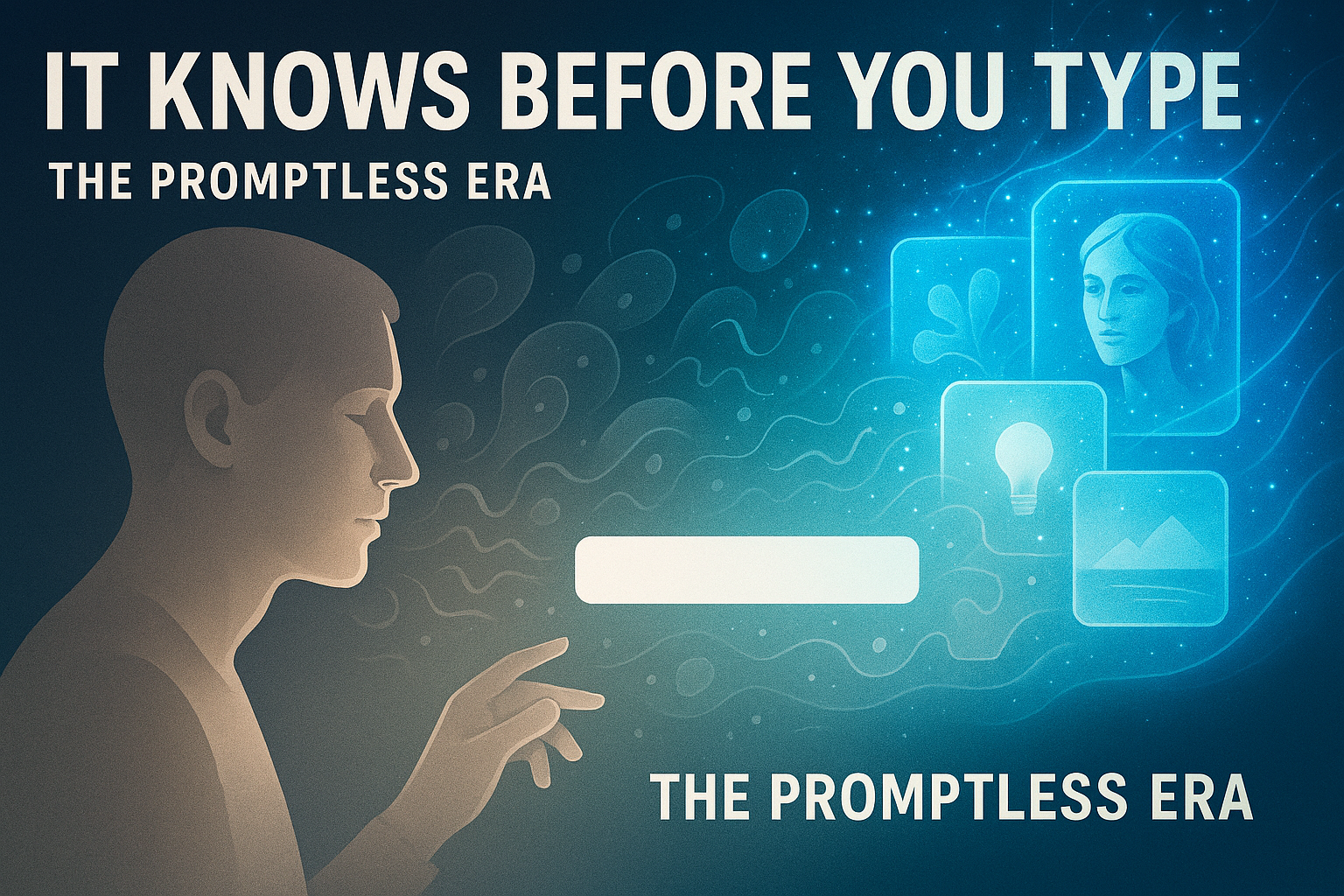
I remember the first time I sat in front of a generative AI interface. It was a blank white box—intimidating, silent, and entirely dependent on me. If I didn’t know the “magic words” (what we eventually started calling prompt engineering), the results were mediocre at best. I spent hours tweaking adjectives and technical parameters just to get a decent image or a coherent paragraph.
Fast forward to today, and that blank box is starting to feel like a relic of the past.
We are entering the era of Promptless AI. It’s a shift from “command and control” to “anticipate and assist.” The latest wave of AI generators isn’t waiting for you to type a 50-word instruction; they are predicting what you want before your fingers even hit the home row.
If you’ve felt “prompt fatigue”—the mental tax of having to be a part-time programmer just to use a creative tool—this is the breakthrough you’ve been waiting for.
Why Prompt Engineering is Dying (and That’s a Good Thing)
For the last couple of years, “Prompt Engineer” was touted as the hottest job in tech. But let’s be honest: having to speak to a computer in a highly specific, pseudo-code language isn’t a feature; it’s a friction point.
The goal of technology has always been to remove the “middleman” between an idea and its execution. The “Promptless” revolution is the final bridge.
Instead of requiring you to describe the lighting, the lens type, and the artistic style of an image, new models are using Intent-Based Architecture. They look at your past work, your current project context, and even your real-time “micro-behaviors” (like where you’re hovering or what you just deleted) to fill in the blanks.
How AI “Reads Your Mind” Without Being Creepy
It sounds like sci-fi, but the mechanics are grounded in something called Multimodal Context.
In the old days (last year), AI only knew what was in the chat box. Today, the latest generators—like the 2026 iterations of Google’s Gemini and OpenAI’s latest models—operate as “Agentic” systems. They have access to a much broader “world view”:
- Environmental Context: If you’re working in a slide deck about Q3 financial projections, the AI doesn’t need you to tell it to “use professional charts.” It already knows the vibe, the data source, and the audience.
- Sequential Learning: The system remembers that you hate the color orange and that you prefer punchy, three-sentence paragraphs. It applies these “hidden preferences” to every output without you ever mentioning them.
- Predictive Intent: Much like how Google Maps predicts you’re going to work at 8:00 AM, creative AI is beginning to predict the next step in your workflow. If you just generated a logo, the AI is already drafting the business card and the social media header in the background.
The Rise of the “Zero-Click” Creative Process
We’re seeing this play out across three major pillars of digital life:
1. Proactive Search and Discovery
Search engines are evolving into “Answer Engines” that don’t wait for a query. By 2026, your AI assistant will likely surface a 10-minute briefing on a news topic before you ask, simply because it saw you open three related tabs and knows you have a meeting on the subject in an hour.
2. Self-Correcting Design
In tools like Photoshop or Canva, we’re moving away from manual sliders. “Promptless” means you can move a 2D object, and the AI automatically adjusts the lighting, shadows, and reflections based on the rest of the image. You didn’t “prompt” the shadow; the AI inferred it was necessary for the scene to remain logical.
3. Context-Aware Writing
The new standard for word processors isn’t just “Autocomplete.” It’s “Auto-Context.” If I’m writing a skeptical review of a new gadget, my AI co-writer won’t suggest flowery, promotional language. It adopts my skepticism because it has analyzed the sentiment of my first two paragraphs.
The Human Side: Does This Kill Creativity?
I get asked this a lot: If the AI is doing the thinking, what am I doing?
As someone who has lived in the digital trenches for a decade, I see it differently. Promptless AI doesn’t kill creativity; it kills drudgery.
Think of it like moving from a manual transmission car to an autonomous one. You still decide the destination. You still decide the “why” and the “who.” The AI just handles the thousands of micro-adjustments required to get there.
By removing the “syntax barrier,” we are actually democratizing creativity. The person with a brilliant vision but a “terrible way with words” can finally see their idea come to life without needing to master the art of the 500-word prompt.
What’s Next: From Tools to Teammates
The “Promptless” era marks the moment AI stops being a tool you use and starts being a teammate you collaborate with.
We are moving toward a world where “The Blank Page” no longer exists. Every time you open a creative app, you’ll be greeted by a “Starting Point” curated specifically for you, based on your intent, your history, and your unique style.
The revolution isn’t about the AI getting louder; it’s about the technology becoming invisible. And in the world of design and communication, invisible is the highest form of sophisticated.