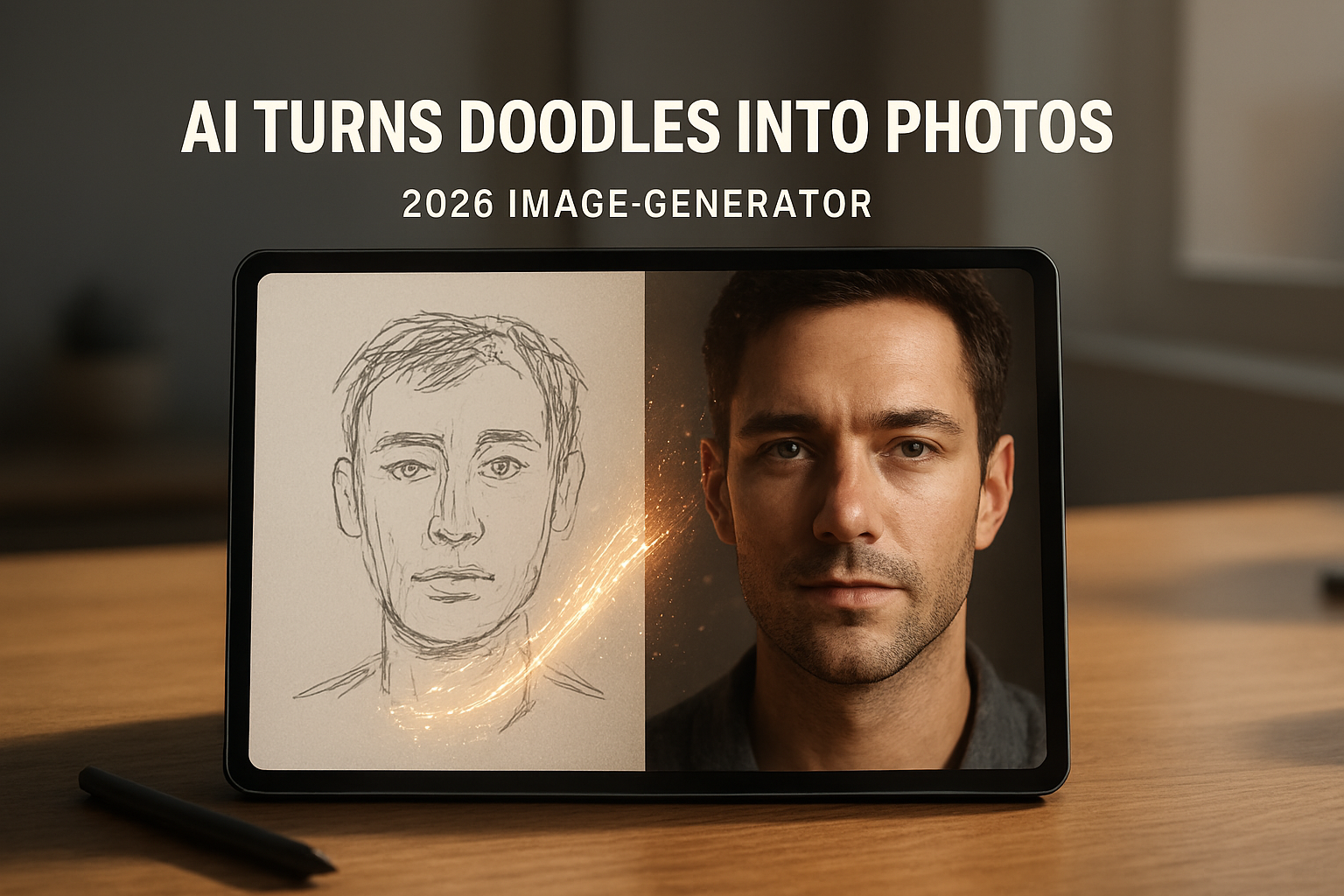
We’ve all been there: a brilliant, vivid image is crystal clear in your mind, but when you try to put it on paper, the result is a frustrating scribble that looks nothing like your vision. For decades, the gap between imagination and execution was a barrier that could only be crossed with years of technical artistic training.
That reality has fundamentally changed. In 2026, a new class of AI technology has eliminated this barrier, empowering anyone to transform a simple sketch into a photorealistic masterpiece in seconds. These tools don’t just guess at what you want; they interpret, refine, and build upon your creative foundation with stunning accuracy.
This post explores the four most surprising and impactful developments in the world of AI sketch-to-photo generation. What was once science fiction is now a practical tool, and the results are changing the creative landscape forever.
Four Mind-Blowing Takeaways from the New Era of AI Art
1. Your Sketch is Now the Blueprint, Not Just a Vague Suggestion
The most fundamental shift in modern AI art generation is how it treats your initial doodle. Unlike older tools that merely used a sketch for loose inspiration, the generators of 2026 use it as a strict structural foundation. The lines, shapes, and perspective you draw dictate the final composition with incredible precision.
This leap in fidelity is powered by technology called Conditional Control (ControlNet/T2I-Adapter). This control layer works in concert with powerful diffusion models—the core technology that refines random noise into a coherent image—ensuring the final output is both creative and compliant with your sketch. Tools like Leonardo.Ai, with its “Edge to Image” technology, are prime examples of this principle in action, ensuring the generated photo maintains strict structural fidelity to your original drawing. This transforms the AI from a creative partner into a precision instrument that executes a specific architectural vision.
2. The Final Image Appears As You Draw
The creative process is no longer a slow, step-by-step procedure of sketching, uploading, and waiting. Some of the most advanced tools now offer a lightning-fast, live feedback loop where the photorealistic image updates instantly with every new line you draw. This real-time rendering transforms the act of creation into a dynamic and interactive dialogue with the AI.
Platforms like Leonardo.Ai and Freepik’s Sketch to Image provide this seamless experience. As you sketch a mountain range or outline a portrait, you can see the fully rendered, textured, and lit photograph materialize and evolve right alongside your cursor. It is an experience that redefines the connection between artist and tool.
…allowing you to see the “masterpiece” evolve with every stroke you draw.
This immediate feedback loop radically shortens the path from creative impulse to finished product, fundamentally accelerating professional design and illustration workflows.
3. You Can Literally ‘Paint with Materials’
As the technology matures, highly specialized tools are emerging to serve specific artistic needs. The most striking example is NVIDIA Canvas, a tool designed specifically for landscape artists. Its revolutionary interface does away with a traditional color palette entirely.
Instead, creators paint with “materials.” You select a brush for grass, snow, clouds, or water and paint simple shapes onto the canvas. The AI then instantly renders these strokes as ultra-realistic scenery, complete with appropriate textures and lighting. Underscoring its professional focus, NVIDIA Canvas can even export the final scenes as 360° panoramas for use in 3D applications. This level of specialization signals the technology’s maturation, positioning it to disrupt established pipelines for creating concept art in the film and gaming industries.
4. It’s Both Indistinguishable From Reality and Instantly Accessible
The sketch-to-photo landscape in 2026 is defined by two parallel developments: the relentless pursuit of absolute photorealism and the radical democratization of the technology.
At the highest end, tools like Google DeepMind’s Nano Banana Pro are widely regarded as the king of photorealism and speed. It leverages a sophisticated “physics engine” that renders complex textures like glass, metal, and water in a way that is often indistinguishable from reality.
Simultaneously, this power is not confined to elite software suites. Canva’s “Sketch to Life” feature strategically democratizes this technology, embedding a “good enough” version directly into the workflow of millions of marketers, social media managers, and small business owners who need quality visuals without the steep learning curve.
Conclusion: Where Does Creativity Go From Here?
The barriers to visual creation are crumbling. AI has undergone a paradigm shift, learning to follow structural rules from our sketches, collaborate with us in real-time, serve highly specific creative niches, and become available to everyone. The ability to produce a photorealistic image is no longer a matter of technical skill but of creative direction.
This new reality leaves us with a profound question. When the primary bottleneck is no longer your ability to draw, but the clarity and originality of your imagination, what will we choose to create?