s were starting to feel like a calculator in a quantum-computing world.
So, I did what any self-respecting tech enthusiast would do: I handed the keys to my financial life to an AI agent.
I didn’t just ask for a “budget.” I fed a secure, privacy-focused AI model my last 12 months of banking data, my investment goals, and my 2026 aspirations. I expected it to give me a pat on the back. Instead, it gave me a reality check.
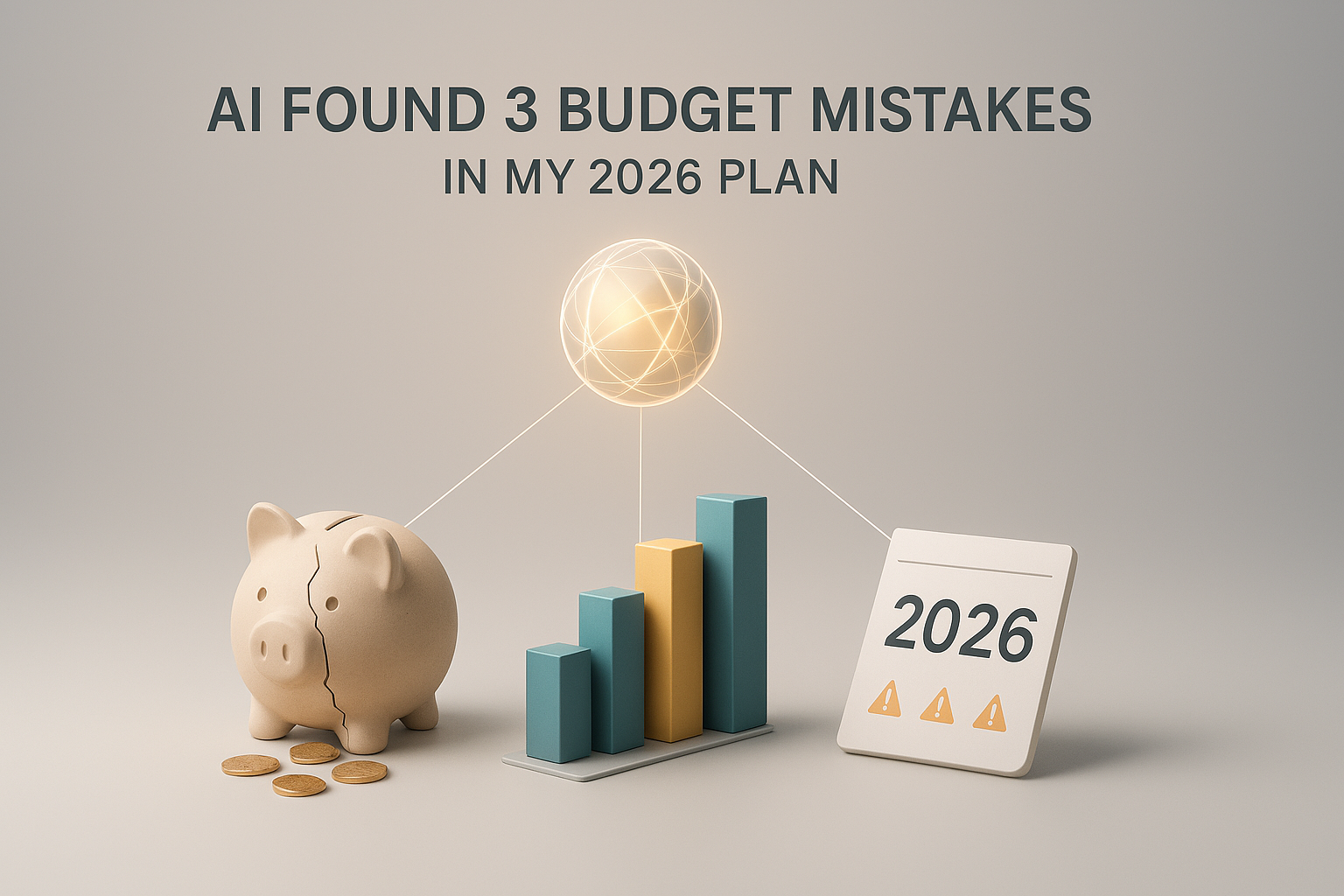
Here are the three glaring mistakes the AI caught in my 2026 financial plan—and why you’re probably making them too.
1. The “Subscription Creep” was Actually a “Subscription Avalanche”
We all know about the $15 Netflix bill. What I didn’t realize—and what the AI caught in seconds—was the sheer volume of “micro-services” that had embedded themselves into my life.
The AI didn’t just list my subscriptions; it categorized them by “Utility vs. Joy.” It flagged six different “premium” features on apps I haven’t opened since 2024. But the real “gotcha” was the inflationary adjustment.
The Insight:
The AI pointed out that while I budgeted $200 for “Digital Services,” the actual historical trend showed a 12% year-over-year increase in those specific costs. It predicted that by mid-2026, my current “fixed” subscription cost would eat an extra $40 a month simply due to price hikes I hadn’t accounted for.
The Fix: I didn’t just cancel apps. I switched to annual billing for the essentials (saving 15%) and set a “hard cap” on digital discretionary spend that the AI monitors in real-time. If I try to sign up for a new Trial, my AI assistant pings me: “This puts you 4% over your 2026 Digital Cap. Proceed?” It’s the digital equivalent of a friend slapping a candy bar out of your hand.
2. My “Emergency Fund” Was Stuck in 2022
This was the most humbling correction. I’ve kept $15,000 in a high-yield savings account for years. In my head, that was the gold standard—six months of expenses.
The AI disagreed. It ran a Monte Carlo simulation (a fancy way of saying it ran 10,000 “what-if” scenarios) based on 2026’s specific economic indicators: higher-than-average local rent increases and a spike in healthcare premiums.
The Insight:
The AI flagged that my “six-month” fund was now actually a 4.2-month fund. My lifestyle had scaled, inflation had bitten, and my safety net had shrunk without me moving a muscle. It also caught a “Risk Mismatch”—I was holding too much cash in a 4% account while 2026 market trends suggested a shift toward specific “Green Bonds” that were outperforming my savings rate with similar liquidity.
The Fix: I adjusted my monthly “Top-Off” contribution. Instead of a flat $100, the AI suggested a dynamic contribution—it looks at my “Leftover” at the end of each week and automatically sweeps a calculated amount into the fund to get me back to a true 6-month buffer by June.
3. The “Phantom Tax” of Inefficient Side-Hustle Spending
Like many of us in 2026, I have a side gig (freelance consulting). I thought I was being smart by “writing off” expenses. The AI, however, looked at my Real-Time Tax Liability and found a massive leak.
The Insight:
The AI identified that I was paying for equipment and software through my personal account and “reimbursing” myself later. It calculated that I was losing roughly $1,100 a year in potential tax-deferred growth by not utilizing a specific 2026 small-business clearing account that automates deductions at the point of sale.
Essentially, I was giving the government an interest-free loan every month because my “plan” relied on me being organized at the end of the year, rather than being efficient in the moment.
The Fix: I linked my business income to an automated tax-withholding agent. Now, the second a client pays me, the AI splits the money: 30% to taxes (earning interest in a dedicated bucket), 20% to business reinvestment, and 50% to my personal “Pay.” No more “tax season panic.”
Why 2026 is the Year of the “Living” Budget
The biggest takeaway from this experiment wasn’t a specific number. It was the realization that a budget is no longer a static document. In the past, we built a budget in January and ignored it until December. In 2026, the world moves too fast for that. Between AI-driven market shifts and the “Amazon-ification” of every cost, our financial plans need to be as “agentic” as the tech we use.
How to do this yourself (without being a tech genius):
- Audit your “Data Silos”: Stop looking at your bank app and your investment app separately. Use a tool that aggregates them so the “big picture” is visible.
- Ask for “Anomalies,” not “Totals”: Don’t just ask AI “How much did I spend?” Ask “What spend doesn’t fit my 3-year trend?” That’s where the mistakes hide.
- Trust, but Verify: AI is a “Budget Spell-Checker,” not the Author. It caught my math errors and my “optimism bias,” but I still had to make the final call on what stayed and what went.
Giving up control of my spreadsheet was scary. But seeing the $3,400 in “recovered” wealth the AI found for my 2026 plan? That felt like the smartest investment I’ve made all year.