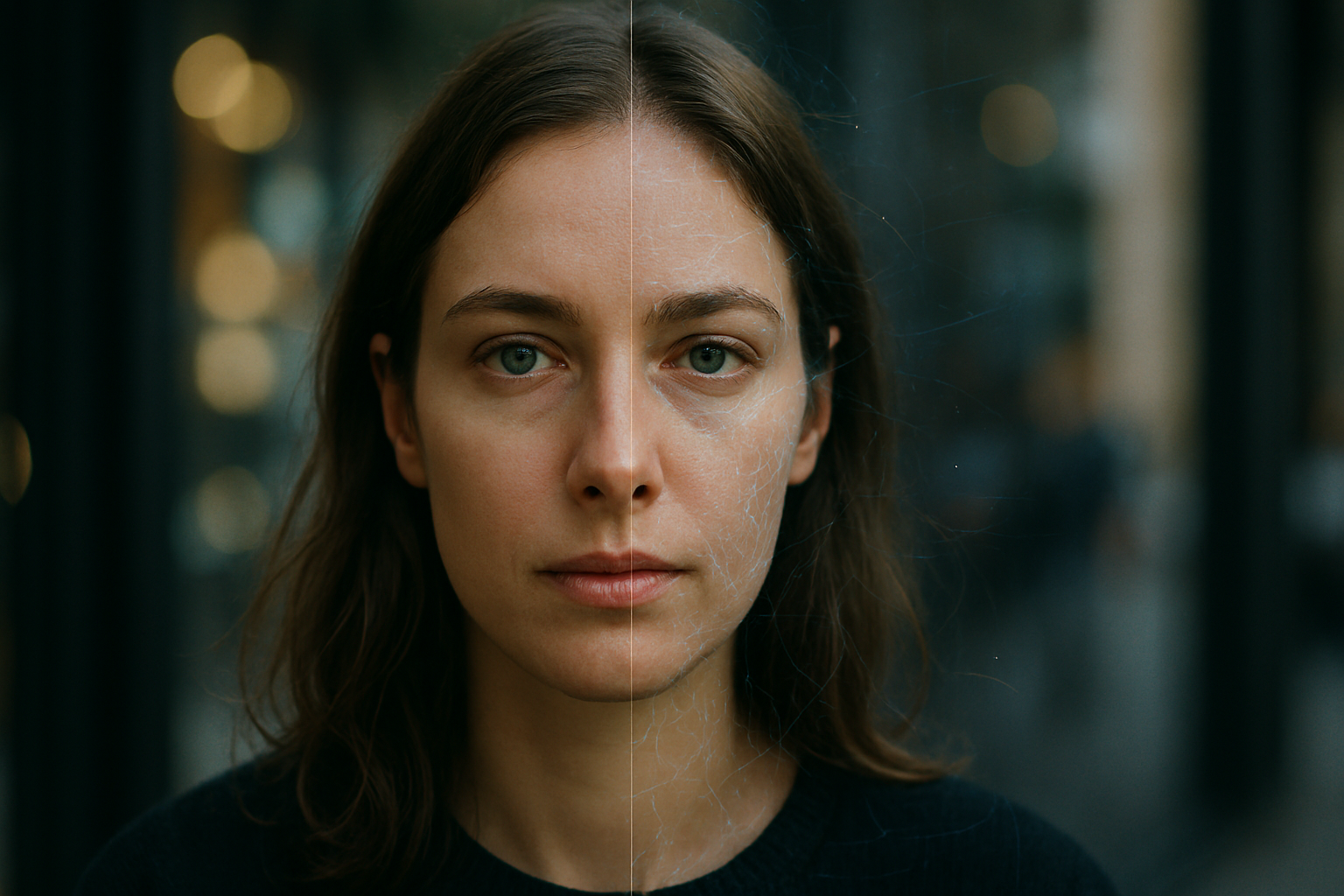
Have you ever stopped scrolling and stared at an image, a nagging question in the back of your mind: “Is this real?” That moment of uncertainty is becoming a universal digital experience. As we navigate our feeds, the line between authentic photographs and sophisticated AI-generated images has blurred to the point of being invisible.
For years, we’ve relied on a mental checklist to spot the fakes—looking for inhumanly perfect skin or a bizarrely rendered hand. But that era is ending. The technology has outpaced our intuition, rendering the old tricks increasingly obsolete and setting the stage for a reality, even by 2026, where our eyes are simply no longer equipped for the challenge. This article explores the surprising new reality of digital imagery and outlines a more reliable, modern approach to determining what’s real and what’s synthetic.
1. The “Too Perfect” Clue is Dead
There has been a counter-intuitive but critical shift in AI image generation: imperfection is now a mastered skill. We used to be able to spot AI art because it looked too clean, too sterile, or too flawless. Now, as India TV News notes, AI models are explicitly trained to generate the “messy” and imperfect look of real photos, complete with subtle flaws and natural-looking textures. This development directly undermines one of our most common instincts for spotting fakes, making the “too perfect” clue entirely unreliable.
2. Looking for Wonky Hands and Weird Text is a Losing Game
The classic AI “tells”—those visual artifacts that once gave the game away—are rapidly becoming unreliable. As Medium reports, clues like warped hands and wobbly or nonsensical text are fading fast with each new model update. Other traditional giveaways, such as inconsistent lighting, overly smooth skin textures, jumbled backgrounds, unnatural reflections, and repetitive patterns are also being systematically corrected. While CNET points out that hands “often still have extra or fused fingers” upon close inspection, these flaws are becoming far more subtle. It’s also worth checking the corners for tiny watermarks from AI companies, but even these are not a given. Relying on these fading visual checks is becoming a dangerous habit. In an era where synthetic media is increasingly sophisticated, looking for yesterday’s flaws leaves us vulnerable to tomorrow’s deceptions.
3. The Real Clues Aren’t in the Pixels Anymore
As visual inspection becomes futile, the focus must shift from what we can see in the image to the data hidden within and around it. Authenticity is no longer a matter of pixel-perfect analysis but of technological provenance. The most reliable strategies for verification are now based on an image’s origin story, not its appearance.
• Content Credentials: Look for embedded metadata from systems like C2PA (Coalition for Content Provenance and Authenticity). These are cryptographically secure records—like digital “nutrition labels”—attached to a file at the moment of creation, providing a verifiable log of its origin and any subsequent edits.
• Watermarking Systems: Technologies like Google’s SynthID embed imperceptible metadata directly into an image’s pixels, creating another layer of verifiable origin that is harder to strip away.
• Reverse Image Search: AI-generated images often have a limited digital footprint. A real photograph, especially of a notable event, will likely appear across multiple trusted sources. A synthetic image may have few, if any, other instances online.
As Medium suggests, this change requires a fundamental adjustment in how we approach online media.
Ultimately, the goal is a shift in mindset: considering potential fakes and relying on technological provenance over visual inspection.
4. The New Question: “Who Posted This?”
In an environment of what India TV News calls an “infinite abundance” of convincing AI-generated content, the most powerful tool for verification has nothing to do with the image itself. The most important question you can ask is: “Who posted this?” Verifying the source is now more critical than analyzing the pixels. As suggested by India TV News, investigating the credibility, history, and reputation of the person or organization sharing an image provides a far more accurate gauge of its authenticity than simply trusting your eyes.
Conclusion: A New Literacy for a New Reality
Our ability to instinctively trust what we see online is diminishing with every technological leap. The skills we once used to navigate the digital world are no longer sufficient. We are now required to develop a new form of digital literacy—one founded not on visual intuition, but on critical thinking, source verification, and an understanding of technological provenance. This is the new reality of consuming information.
As the line between real and synthetic vanishes, how will we redefine what it means to trust what we see?