I remember the first time I felt “search fatigue.” I was looking for a specific, honest review of a new espresso machine. I spent ten minutes scrolling past three “sponsored” listings, four AI-generated “best of” lists from sites I’d never heard of, and a dozen paragraphs of SEO fluff before I finally found a human opinion on Reddit.
For most of us over thirty, that’s just “the internet.” But for Gen Z? They aren’t doing that anymore.
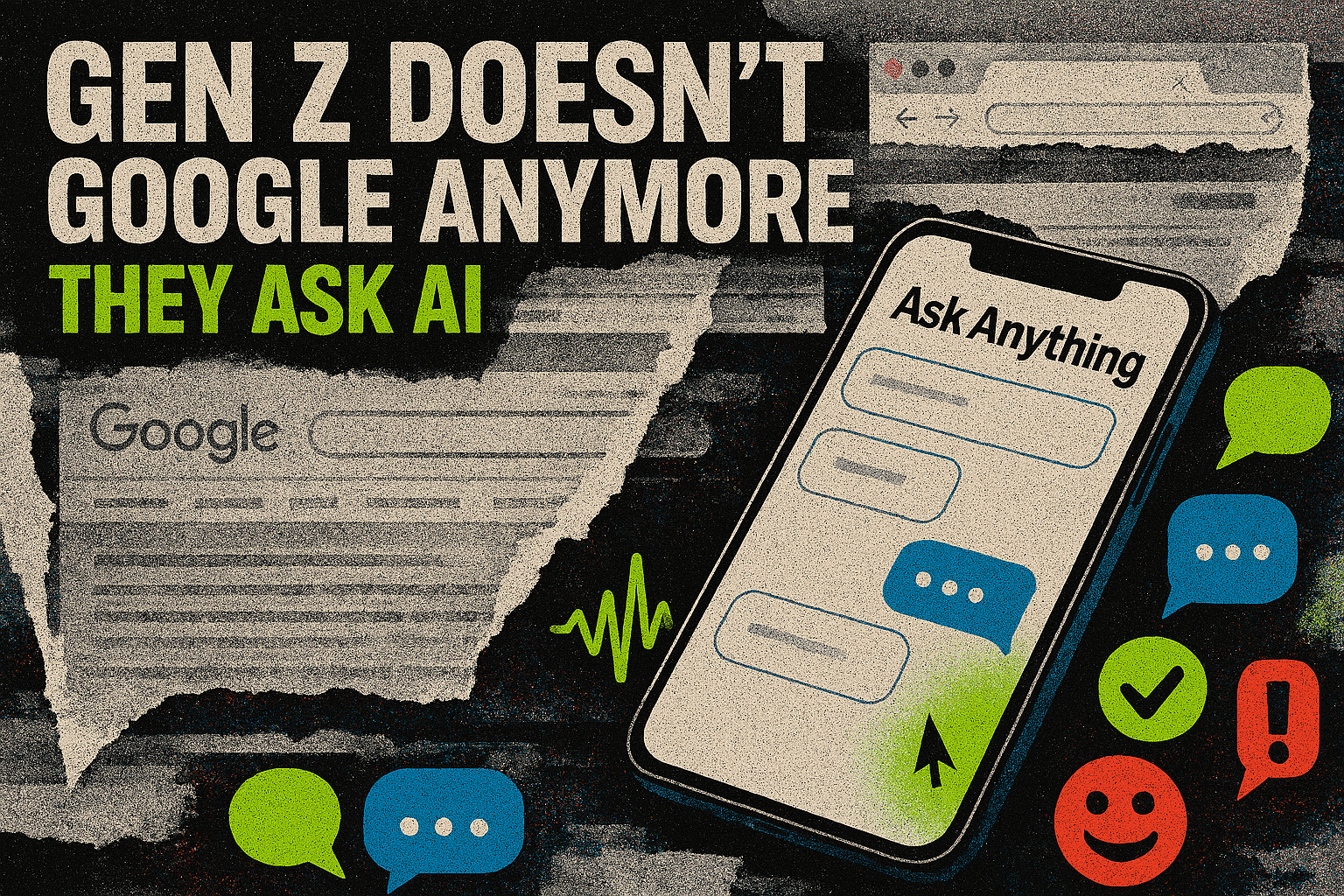
In 2026, the phrase “Google it” is starting to sound as antique as “page me.” We are witnessing a fundamental divorce between the younger generation and the traditional search engine. It’s not just a trend; it’s a total migration toward “Ask AI” apps like Perplexity, ChatGPT, and Gemini.
If you want to understand why the world’s most powerful search engine is losing its grip on the next generation of consumers, you have to look past the tech and look at the behavior.
The ‘Blue Link’ Tax: Why Traditional Search Feels Like Work
To a 20-year-old in 2026, Google feels like a library where you have to find the book, check the index, and read three chapters just to find out if the library actually has what you need. They call it the “Blue Link Tax.”
Traditional search engines provide resources, but Gen Z wants answers.
When a Gen Zer asks, “What’s the best way to get a red wine stain out of a vintage wool rug without ruining the dye?”, they don’t want a list of ten blogs titled 10 Cleaning Hacks You Need To Know! (where the actual answer is buried under a life story about the author’s grandmother).
They want the answer—formatted, cited, and immediate. AI apps give them exactly that. By the time a Google user has clicked their second link, a Perplexity user has already started the laundry.
1. Context Over Keywords
The biggest shift we’re seeing in 2026 isn’t just speed; it’s nuance.
Gen Z doesn’t search in fragments like “weather Tokyo March.” They talk to their apps like they’re talking to a well-read friend. They use full sentences, complex follow-ups, and highly specific constraints.
- The Google Way: “Vegan restaurants Austin”
- The AI Way: “Find me a vegan spot in Austin that’s quiet enough for a first date, has gluten-free options, and is within walking distance of the East Side.”
AI apps can synthesize those four different requirements into a single, curated recommendation. Google tries to do this with its “AI Overviews,” but for many young users, it feels like a clunky add-on to a system that was fundamentally built for keywords, not conversations.
2. The ‘BS Filter’: Why Authenticity is the New SEO
There is a profound lack of trust in the “Top 10” results of a search engine today. Gen Z has grown up in an era of hyper-optimized content. They know that the first result on Google isn’t necessarily the best answer; it’s often just the site with the biggest SEO budget.
“Ask AI” tools—specifically those like Perplexity—have gained massive traction because of their citation models.
When an AI app says, “This product is highly rated for its durability,” and immediately provides a small footnote linking to a specific Reddit thread or a niche enthusiast blog, it builds a level of trust that a “Sponsored” tag never will. Paradoxically, Gen Z trusts the AI because it shows its work, pulling from the “human” corners of the web (like Reddit and Discord) that Google’s main algorithm often buries.
3. The End of ‘Scroll and Peck’ on Mobile
We have to remember that Gen Z is a mobile-only generation for most of their discovery.
Scrolling through a Search Engine Results Page (SERP) on a 6-inch screen is a chore. It involves dodging pop-up ads, “Accept Cookies” banners, and newsletter sign-ups.
AI search apps provide a clean, chat-based interface. It’s a “one-and-done” experience. You ask a question, you get a bubble with the answer, and you move on with your life. In the attention economy of 2026, the app that requires the fewest thumb-flicks wins.
Is Google Actually Dying?
Not exactly. Google still handles the “utility” of the web—navigational searches like “Log in to my bank” or “Gmail.” But it is losing the discovery and research phases.
Google’s response—Gemini—is a powerhouse, and it’s actually one of the reasons why the “Ask AI” habit is sticking. By integrating AI directly into the search bar, Google has effectively trained its own users to stop looking at the links below.
The irony is that by making search better with AI, Google is cannibalizing the very ad-click model that built its empire.
What This Means for the Rest of Us
If you’re a creator, a business owner, or a marketer, the “Search” playbook has officially changed. Ranking #1 for a keyword is no longer the “holy grail.”
The new goal is “Generative Engine Optimization” (GEO)—or, more simply, being the brand that the AI chooses to cite.
- Stop writing for bots: If your content is generic, AI will summarize it without sending you a single click.
- Be the ‘Deep Subject’ expert: AI looks for specific, unique insights it can’t find elsewhere.
- Prioritize trust: Citations on Reddit and niche forums now carry more weight for AI discovery than a hundred low-quality backlinks.
The Bottom Line
Gen Z isn’t “lazy” for using AI to search; they’re efficient. They’ve realized that in an era of information overload, the most valuable tool isn’t the one that gives you the most results—it’s the one that gives you the right one.
As we move deeper into 2026, the search bar is becoming a conversation. And for the first time in twenty years, Google isn’t the only one talking.