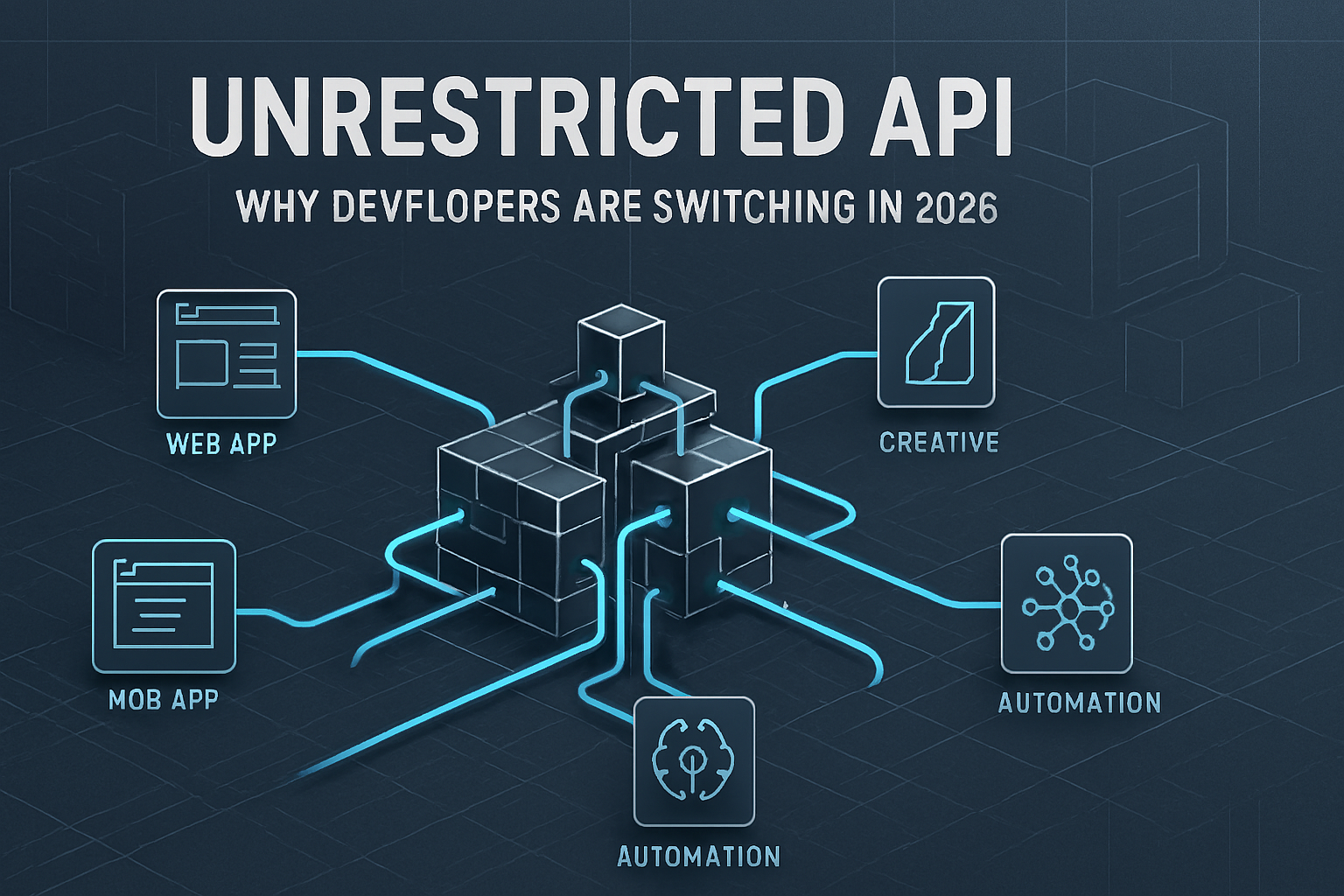
If you’ve spent any time in a developer Slack channel lately, you’ve likely noticed a shift in the vibe. Two years ago, OpenAI was the only name that mattered. Today? The conversation has turned.
While OpenAI continues to build massive, sophisticated “black box” models, a growing number of engineers are quietly moving their 2026 production pipelines over to DeepAI.
It’s not because OpenAI’s models aren’t smart—they’re brilliant. It’s because for developers trying to build the next generation of unfiltered, creative, or high-velocity applications, the “safety guardrails” at OpenAI have started to feel more like a straitjacket.
Here is the real-world look at why the “Unrestricted API” movement is picking up speed and why DeepAI is becoming the go-to choice for the 2026 dev cycle.
1. The Fatigue of the “As an AI Language Model…” Era
We’ve all been there. You’re building a creative writing tool, a historical role-play bot, or a cybersecurity simulation, and your API call returns a lecture instead of a result.
OpenAI has doubled down on safety and alignment. In 2026, their moderation layers are more aggressive than ever. For enterprise tools, that’s a feature. For developers pushing the boundaries of edge cases, it’s a bug.
DeepAI’s “Unrestricted” Philosophy DeepAI has carved out a niche by offering what they call a more “raw” experience. Their APIs are designed to follow the prompt first and the policy second.
- Creative Freedom: If you’re building an uncensored RPG or a gritty noir storytelling engine, DeepAI doesn’t wag its finger at you.
- Reduced Latency: Because there are fewer “alignment checks” running in the background for every token generated, developers are reporting snappier response times for complex prompts.
2. Predictable Pricing vs. Token Anxiety
In 2026, OpenAI’s pricing has become a complex matrix of reasoning tiers, cached input discounts, and multimodal credits. It’s great for saving pennies if you have a dedicated “AI Ops” person, but it’s a headache for a solo dev or a small startup.
The “Wallet” System DeepAI uses a refreshingly simple prepaid wallet system.
- You pay $5 or $10.
- You use it until it’s gone.
- There are no “tiers” to unlock or hidden “reasoning” surcharges that double your bill overnight.
For developers building MVP (Minimum Viable Products), knowing exactly what a thousand requests will cost—without worrying about “system prompt overhead” or “context window bloat”—is a massive relief.
3. The “Genius Mode” vs. The “O1” Complexity
OpenAI’s new models (like the o1 series) are incredibly powerful at math and logic, but they are slow. They spend seconds “thinking” before they even start typing.
DeepAI’s Genius Mode offers a middle ground. It provides the reasoning capabilities developers need for 2026’s more agentic tasks, but without the “black box” wait times associated with OpenAI’s heavy-duty reasoning models.
Developers are finding that for 80% of use cases—code generation, image manipulation, and standard chat—DeepAI’s Genius Mode is “good enough” while being significantly more flexible for integration.
4. Ownership and the “Private Image” Advantage
One of the biggest friction points for developers in 2026 is data sovereignty. OpenAI’s terms, while improved, still feel like you’re renting a brain that is constantly reporting back to the mothership.
DeepAI has leaned into a “Your Data is Yours” stance that resonates with the 2026 privacy-first movement.
- Private Image Handling: Their image APIs don’t store your generations by default for “research” in the same way some public-facing competitors do.
- No Mandatory Feedback Loops: You aren’t forced into “RLHF” (Reinforcement Learning from Human Feedback) cycles that might inadvertently leak your app’s unique prompting logic back into the base model.
5. The “API-First” Developer Experience
Let’s be honest: OpenAI’s developer dashboard has become cluttered. Between GPTs, Assistants API (which saw significant changes recently), and the new “Responses” API, keeping up is a full-time job.
DeepAI’s documentation is notoriously minimalist. It’s a “copy-paste and go” environment.
- Standardized Endpoints: They don’t change their API structure every three months.
- Reliable Uptime: While OpenAI has struggled with “capacity issues” during major model launches, DeepAI’s infrastructure has proven remarkably stable for those who just want their app to work on a Tuesday morning.
The Verdict: Which One Should You Choose?
If you are building a Fortune 500 HR tool where safety and compliance are the only things that matter, OpenAI is still the gold standard. Their safeguards are there for a reason.
However, if you are a 2026 developer who is:
- Building a creative or “unfiltered” application.
- Working with a tight, predictable budget.
- Tired of “moralizing” AI responses.
- Looking for a fast, simple integration without the corporate bloat.
Then DeepAI isn’t just an alternative—it’s the logical choice. The “unrestricted” era isn’t about being “bad”; it’s about being unbound.