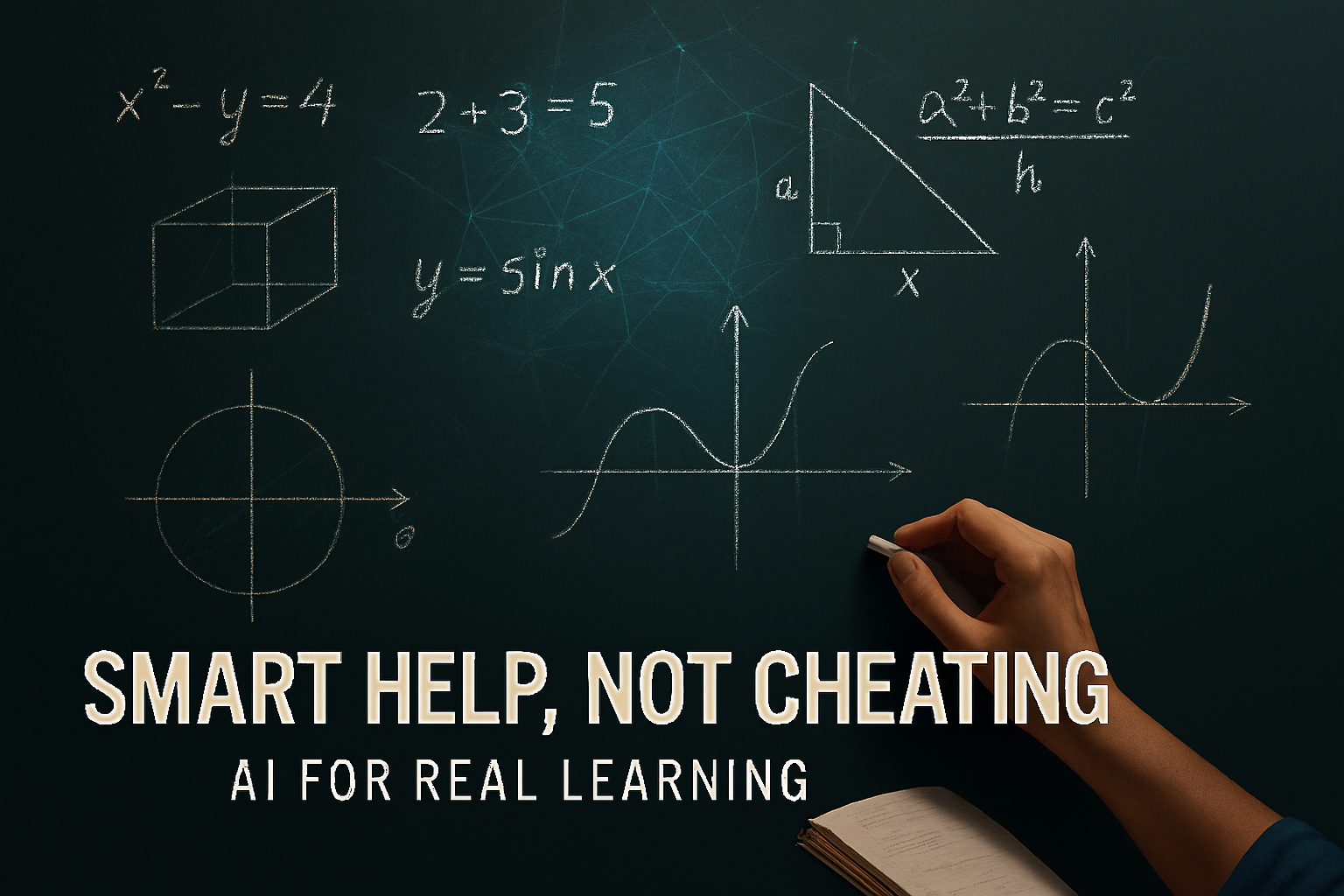
It’s 9:45 PM on a Tuesday. Your teenager is hunched over a geometry packet, the dining room table is covered in erasable pen marks, and the “simple” triangle problem they’re stuck on looks like a secret code from a spy thriller.
As a parent or a student, you know this feeling. It’s the “Math Wall.” You want to help, but let’s be honest: most of us haven’t thought about the Law of Cosines since the late 90s.
In the past, this was the moment where frustration turned into one of two things: a late-night argument or a desperate “copy-paste” from a shady answer site. But there’s a new “Back to School” secret quietly changing the game. It’s called Question AI, and contrary to the “AI is for cheating” headlines you might have seen, it’s actually becoming the most powerful tool we have for building genuine math confidence.
Here is why this tech is finally solving the math crisis—without taking the easy way out.
The “Step-by-Step” Revolution: Learning the “How,” Not Just the “What”
The biggest misconception about AI in the classroom is that it’s a “magic answer machine.” If you just want a number, a calculator from 1985 can give you that.
The reason Question AI is different is that it focuses on the procedural logic. When a student scans a problem with their phone, they don’t just get “$x = 5$.” They get a structured breakdown:
- The Setup: Why we’re using this specific formula.
- The Middle: The algebraic moves (like isolating variables) that usually cause the most confusion.
- The Check: How to verify the answer makes sense.
Think of it like GPS for your brain. If you’re lost in the woods, a map tells you where you are, but a GPS tells you which turn you missed. By seeing the steps, a student’s “Aha!” moment happens during the homework, not two days later when the teacher hands back a graded paper covered in red ink.
24/7 Tutoring for the Price of… Nothing
Let’s talk about the “tutoring gap.” Traditional private math tutoring can cost anywhere from $50 to $150 per hour. For many families, that’s simply not an option. Even for those who can afford it, tutors aren’t available at 10:00 PM when the actual struggle is happening.
Question AI acts as a non-judgmental, infinitely patient tutor that lives in a pocket.
“The best part? It doesn’t get frustrated when you ask ‘Why?’ for the fifth time. It doesn’t roll its eyes when you forget how to divide fractions. It just re-explains the concept in a different way.”
This 24/7 accessibility levels the playing field. It ensures that the kid whose parents are working late shifts has the same “on-demand” support as the kid with a private coach. It’s not about finding a shortcut; it’s about having a safety net.
Breaking the Cycle of “Math Anxiety”
Math anxiety is a real psychological barrier. When a student hits a wall and has no way over it, their brain enters “fight or flight” mode. They shut down. They decide, “I’m just not a math person.”
AI breaks this cycle by providing instant feedback. Research shows that “feedback delayed is learning denied.” If a student does 20 problems incorrectly and doesn’t find out until the next day, they’ve effectively “learned” the wrong way to do them.
By using an AI partner to check their work as they go, students catch their own misconceptions in real-time. That instant correction builds a sense of mastery. Suddenly, math isn’t a monster to be feared; it’s a puzzle that actually has a set of rules they can follow.
How to Use AI Without Crossing the Line
If you’re a parent or educator worried about “academic integrity,” the secret lies in how the tool is used. Here is the “Pro-Student” way to use Question AI effectively:
- The “Reverse Engineer” Method: Try the problem first. If you get stuck, use AI to see the first two steps only. Then, put the phone down and try to finish the rest yourself.
- The “Explain it to Me” Prompt: Instead of asking for the answer, ask the AI: “Can you explain the concept of Pythagorean theorem using a sports analogy?”
- The “Double Check” Strategy: Treat the AI like a teaching assistant. Finish your worksheet, then scan it to see if your logic holds up. If the AI gets a different answer, figure out who’s right. (Spoiler: Sometimes the student is!)
The Verdict: A New Tool for a New Era
We’re moving past the era of rote memorization. In a world where every adult has a supercomputer in their pocket, the “skill” isn’t knowing the answer—it’s understanding the process and knowing how to use the tools available to solve complex problems.
Question AI isn’t a threat to education; it’s the evolution of it. It’s helping a generation of students realize that they are “math people” after all—they just needed a little help finding the right path.