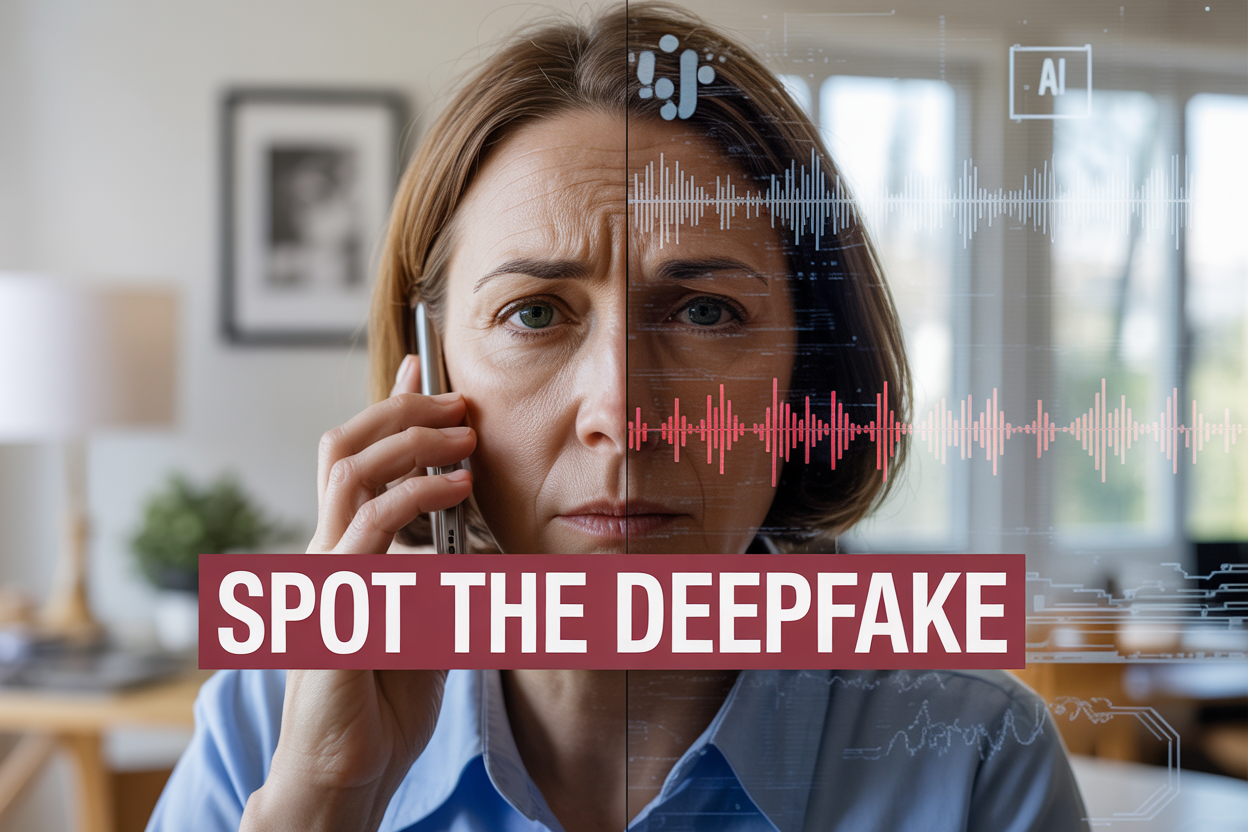
Deepfake voice calls are becoming scarily realistic, and scammers are using this AI technology to impersonate loved ones, bosses, and trusted contacts to steal money and personal information. If you’ve ever received a suspicious call that sounded almost right but felt off somehow, you might have encountered a deepfake voice call.
This guide is for anyone who wants to protect themselves and their families from AI voice scams – whether you’re concerned about elderly parents falling victim to fake emergency calls or worried about workplace fraud targeting your business.
We’ll walk you through three telltale signs that can help you spot deepfake voice calls: unusual speech patterns that don’t quite match natural conversation flow, audio quality issues that reveal the artificial nature of the voice, and content inconsistencies that expose the scammer’s lack of real knowledge about you or your relationship. You’ll also learn simple verification steps you can take during any suspicious call to confirm who’s really on the other end of the line.
Understanding the Growing Threat of Deepfake Voice Technology
How AI voice cloning has become accessible to criminals
Voice cloning technology has shifted from science fiction to everyday reality in just a few short years. What once required expensive equipment and technical expertise now takes nothing more than a smartphone and a few minutes of audio. Free and paid platforms like ElevenLabs, Murf, and even open-source tools allow anyone to create convincing voice replicas with as little as 10 seconds of source material.
The barrier to entry has essentially disappeared. Criminals can scrape voice samples from social media videos, voicemails, or recorded calls to build synthetic voice models. These tools don’t require coding knowledge or specialized training – many feature simple drag-and-drop interfaces that make voice cloning as easy as uploading a photo to Instagram.
The democratization of this technology means scammers operating from anywhere in the world can impersonate your family members, colleagues, or trusted contacts. What’s particularly troubling is how quickly the quality has improved while costs have plummeted. Premium voice cloning services now cost less than $50 per month, making them accessible to organized crime groups and individual fraudsters alike.
Real-world cases of deepfake voice scams targeting individuals and businesses
The headlines tell a sobering story. In 2023, a Hong Kong-based multinational company lost $25 million when criminals used deepfake technology to impersonate the CFO during a video conference call. The finance team, believing they were following legitimate instructions from senior leadership, authorized multiple money transfers before realizing the deception.
Families aren’t immune from these attacks either. Elderly parents regularly receive calls from what sounds exactly like their adult children, claiming to be in emergency situations requiring immediate financial help. In Arizona, a mother received a call from her “daughter” sobbing and claiming to have been kidnapped. The voice was so convincing that she nearly wired $15,000 before her actual daughter called from work.
Business email compromise schemes have evolved to include voice verification steps. Scammers now call finance departments using cloned voices of executives to confirm fraudulent wire transfer requests that were initially sent via email. This multi-channel approach makes the scams significantly more convincing and harder to detect.
Romance scams have also adopted this technology, with fraudsters using cloned voices to build deeper emotional connections with victims over months or years. Dating app users report receiving voice messages that perfectly match profile photos, only to discover later that both the images and audio were artificially generated.
The financial and personal risks you face from voice impersonation
The financial impact of voice deepfake scams extends far beyond the immediate monetary loss. Businesses face regulatory fines, legal liability, and severe reputation damage when customer data or funds are compromised. The average cost of recovering from a successful voice impersonation attack includes forensic investigations, legal fees, system security upgrades, and potential lawsuit settlements.
Personal victims often struggle with more than just financial loss. The psychological impact of being deceived by a perfect replica of a loved one’s voice creates lasting trust issues. Many report feeling violated and questioning their ability to distinguish reality from deception in future interactions.
Insurance coverage for these attacks remains inconsistent and often inadequate. Traditional fraud policies may not cover losses from AI-generated content, leaving victims to absorb the full financial impact. Even when coverage exists, proving that a loss resulted from deepfake technology rather than traditional fraud can be challenging and time-consuming.
The ripple effects touch entire social networks. When one person falls victim to a voice cloning scam, criminals often use information gathered during that attack to target friends, family members, and colleagues. Your voice sample, once compromised, can be used indefinitely to create new scams targeting anyone in your contact list.
Credit scores and financial standing can take years to recover after a successful attack. Beyond immediate monetary theft, criminals often use the trust established through voice impersonation to gather sensitive personal information for identity theft, opening new credit accounts, or accessing existing financial services.
The First Warning Sign: Unnatural Speech Patterns and Timing
Identifying Robotic or Mechanical Speech Rhythms
Human speech flows naturally with subtle variations in rhythm, emphasis, and cadence. Deepfake voice technology, despite its advances, often struggles to replicate these organic patterns perfectly. When listening to a suspicious call, pay attention to how the person speaks. Real human conversation includes natural hesitations, slight stumbles, and the organic ebb and flow of thought processes.
Artificial voices frequently exhibit an unnaturally consistent rhythm, almost like a metronome keeping perfect time. Each word receives similar emphasis and spacing, creating a mechanical quality that lacks the spontaneous variations found in authentic speech. The speaker might sound like they’re reading from a script with robotic precision, maintaining the same tempo throughout the entire conversation without the natural speed-ups and slow-downs that characterize genuine human dialogue.
Spotting Unusual Pauses and Breathing Patterns
Breathing is one of the most challenging aspects for AI to simulate convincingly. Real people breathe irregularly during conversation – sometimes holding their breath slightly when concentrating on a thought, taking quick inhales before important statements, or sighing naturally between ideas.
Deepfake voices often have several telltale breathing anomalies:
- Missing breath sounds: Complete absence of natural breathing patterns between sentences
- Mechanical breathing: Artificially inserted breath sounds that occur at perfectly regular intervals
- Misplaced breathing: Breath sounds appearing at grammatically incorrect moments, like mid-sentence rather than at natural pause points
- Uniform breathing: Every breath sound identical in length and intensity
Listen for pauses that feel too perfect or calculated. Humans naturally pause at different lengths depending on their thought process, emotional state, and the complexity of what they’re trying to express. AI-generated speech often creates pauses that are either too uniform or oddly timed.
Recognizing Inconsistent Speaking Pace and Tone Variations
Human voices naturally fluctuate in pace and tone based on emotions, emphasis, and context. We speed up when excited, slow down for important points, and adjust our tone to match the gravity of our message. Deepfake technology struggles with these nuanced adjustments, often producing speech that sounds emotionally flat or inconsistent.
Watch for these pace and tone red flags:
| Natural Speech | Deepfake Speech |
|---|---|
| Variable pacing based on content | Monotonous, steady rhythm |
| Emotional inflection matching context | Flat or inappropriate emotional tone |
| Natural emphasis on key words | Even emphasis throughout |
| Smooth transitions between topics | Abrupt tone changes |
The voice might suddenly shift from one emotional register to another without logical reason – perhaps sounding urgent about mundane details while remaining oddly calm about supposedly important matters. These tonal inconsistencies often reveal the artificial nature of the voice, as the AI hasn’t truly processed the emotional context of the conversation.
Pay special attention to how the speaker handles questions or unexpected topics. Genuine callers naturally adjust their speaking patterns when surprised or when thinking on their feet, while AI voices might maintain the same mechanical rhythm regardless of the conversation’s direction.
The Second Red Flag: Audio Quality and Technical Glitches
Detecting compressed or artificially processed sound quality
AI-generated voices often carry telltale signs of digital compression that trained ears can pick up. Real phone calls have natural audio characteristics that deepfake technology struggles to replicate perfectly. Listen for a metallic or hollow quality in the voice that sounds like it’s been run through heavy processing software. The audio might seem overly crisp in some frequencies while muddy in others, creating an unbalanced sound profile that human vocal cords don’t naturally produce.
Pay attention to how consonants and vowels blend together. Deepfake voices sometimes struggle with seamless transitions between sounds, creating subtle digital artifacts that make words sound pieced together rather than flowing naturally. The overall audio signature might remind you of a heavily compressed MP3 file or voice processed through multiple digital filters.
Listening for background noise inconsistencies
Background audio tells a powerful story about call authenticity. Genuine phone calls pick up ambient sounds from the caller’s environment – air conditioning hums, distant traffic, or the subtle acoustics of the room they’re in. Deepfake calls often present unnaturally clean backgrounds or inconsistent environmental sounds that don’t match the supposed location of the caller.
Watch out for background noise that suddenly appears or disappears without explanation, or audio that sounds like it was recorded in a professional studio when the caller claims to be at home or in an office. Sometimes scammers layer in fake background sounds, but these additions often sound artificial or don’t match the acoustic properties of the voice itself.
Identifying digital artifacts and audio dropouts
Digital processing leaves fingerprints that careful listeners can detect. Brief audio dropouts, micro-stutters, or moments where the voice seems to skip slightly can indicate AI generation. These glitches happen when the synthesis software struggles to maintain consistent output or when network bandwidth affects the real-time processing.
Listen for unusual echoes or reverb that don’t match what you’d expect from a normal phone connection. Some deepfake systems introduce subtle delays or timing issues that create an almost imperceptible “off” feeling during conversation. Audio that cuts out abruptly at word endings or strange pauses mid-sentence can also signal artificial generation.
Recognizing overly perfect audio clarity that seems unnatural
Paradoxically, audio that sounds too good can be suspicious. Most legitimate phone calls have some degree of compression, line noise, or signal degradation. If someone’s voice comes through with pristine, studio-quality clarity while claiming to call from a standard phone line, question the authenticity.
Real human voices have natural variations in volume, breath sounds, and subtle imperfections that AI systems often smooth out too much. A voice that maintains perfectly consistent volume and tone throughout an entire conversation, without natural fluctuations or the small imperfections that make human speech authentic, should raise red flags about its legitimacy.
The Third Giveaway: Content and Contextual Inconsistencies

Questioning Vague or Generic Conversation Topics
Deepfake voice calls often rely on broad, non-specific talking points that could apply to anyone. Scammers using this technology typically stick to safe subjects like weather, general family inquiries, or basic pleasantries because the AI lacks genuine personal knowledge about your relationship.
When someone calls claiming to be a friend or family member, pay attention to how they discuss shared experiences. Real people naturally reference specific memories, inside jokes, or recent conversations you’ve had together. They mention mutual friends by name, recall details about your last meeting, or bring up ongoing situations in your life.
Deepfake callers tend to speak in generalities: “How’s the family?” instead of “How’s Sarah’s new job at the marketing firm?” They avoid mentioning specific places, dates, or personal details that would require intimate knowledge of your life. The conversation feels oddly surface-level, lacking the natural depth that comes from genuine relationships.
Watch for fishing attempts where the caller tries to extract information from you rather than sharing their own knowledge. They might say things like “Tell me about that thing we discussed” without specifying what “thing” they mean, hoping you’ll fill in the blanks and provide context they can then mirror back to you.
Testing the Caller with Personal Questions Only the Real Person Would Know
Create a mental quiz when you suspect a deepfake call. Ask questions that only the genuine person would know the answers to, but make them sound casual and conversational. The key is choosing details that wouldn’t be publicly available on social media or easily guessable.
Effective test questions target shared experiences, private conversations, or family details that outsiders wouldn’t know. Instead of asking “What’s my dog’s name?” (which might be on Facebook), try “What did we laugh about at dinner last Tuesday?” or “What’s that nickname you gave my car?” These questions require specific, personal knowledge that AI systems can’t access.
Family relationships offer particularly good testing ground. Ask about relatives using the specific terms your family member would use: “How’s Nana doing?” instead of “How’s your grandmother?” Real family members know the unique vocabulary and nicknames your family uses internally.
Be prepared for evasive responses. Deepfake callers often deflect specific questions with phrases like “You know how it is” or “Same as always.” They might claim poor memory, suggest they’ll call back later, or try to redirect the conversation back to their original purpose.
Identifying Scripted Responses and Lack of Spontaneous Reactions
Genuine conversations flow with natural interruptions, emotional reactions, and spontaneous tangents. Deepfake voices, however, often sound rehearsed and struggle with unexpected conversational turns.
Real people react authentically to surprising news or unexpected topics. They might gasp, laugh genuinely, or ask follow-up questions that show they’re processing new information. Deepfake systems typically respond with generic acknowledgments or fail to match the appropriate emotional tone to your statements.
Test this by sharing unexpected information or making an unusual comment. See if the caller responds naturally or gives a canned response that doesn’t quite fit the context. Real people might interrupt you mid-sentence with excitement or confusion, while AI-generated voices usually wait for complete pauses before responding with measured, predictable reactions.
Listen for repetitive language patterns or phrases that sound like they came from a script. Deepfake systems often fall back on similar sentence structures or use oddly formal language that doesn’t match how the person normally speaks. The conversation might feel like you’re talking to customer service rather than your actual friend or family member.
Practical Steps to Verify Caller Identity and Protect Yourself

Establishing Code Words with Family and Colleagues
Creating a secret code word system with your inner circle acts like a digital password for voice verification. Choose unique words or phrases that only you and trusted contacts know – something memorable but not easily guessed by outsiders. Your grandmother’s maiden name or the name of your first pet works perfectly. Make sure everyone understands they should always ask for the code word during unexpected calls requesting money, sensitive information, or urgent actions.
Update these code words regularly, especially after suspicious incidents. Keep a secure record of who knows which code words and when they were last changed. For businesses, consider implementing department-specific codes that rotate monthly. The key is making these words natural enough that family members will remember to use them under pressure, but obscure enough that scammers can’t guess them from social media profiles or public records.
Using Callback Verification Methods Effectively
Never handle urgent requests during the initial suspicious call. Instead, hang up and call back using a number you know is legitimate – either from your contacts or by looking it up independently. Scammers often spoof caller ID, making it appear they’re calling from familiar numbers, but they can’t intercept calls you initiate to verified numbers.
When calling back, use a different phone or wait at least five minutes before dialing. This prevents scammers from keeping the line open and pretending to be the legitimate contact when you “call back.” For business situations, use official company directories or websites to find contact information rather than trusting numbers provided during suspicious calls.
Consider establishing callback protocols with elderly family members or vulnerable colleagues who might be targeted. Teach them to always say “I’ll call you back” for any request involving money, passwords, or personal information, no matter how urgent the caller claims the situation is.
Implementing Multi-Factor Authentication for Sensitive Requests
Never rely solely on voice recognition for important decisions. Require multiple forms of verification before acting on phone requests involving financial transfers, password changes, or confidential information sharing. This might include texting a confirmation code, sending an email verification, or requiring physical presence for high-stakes decisions.
For families, establish rules that large financial requests must be confirmed through at least two different communication channels. If someone calls asking for an emergency wire transfer, require them to also send a text, email, or video call showing their face. Businesses should implement similar policies where IT changes, financial authorizations, or data access requests need approval through multiple verified channels.
Create escalation procedures for when verification methods fail. If the callback number doesn’t work or the person can’t provide additional verification, involve additional family members or supervisors in the decision-making process before taking any action.
Creating Awareness Protocols for Your Household and Workplace
Regular training sessions help everyone stay alert to evolving deepfake tactics. Schedule monthly discussions with family members about new scam techniques, sharing real examples from news reports or personal experiences. Make these conversations engaging rather than lecture-style – role-play scenarios where different family members practice being both the caller and the recipient of suspicious calls.
Workplace protocols should include clear reporting chains for suspicious calls. Employees need to know exactly who to contact when they receive questionable requests, whether it’s supposed to be from the CEO, IT department, or external partners. Create quick reference cards with verification steps and emergency contact numbers that employees can keep at their desks.
Document all suspicious call attempts, even unsuccessful ones. This creates valuable intelligence about targeting patterns and helps identify when your household or organization might be under coordinated attack. Share these reports with local law enforcement cyber crime units and relevant industry groups to help protect others from similar schemes.
Establish buddy systems where household members or coworkers check in with each other about unusual requests. Sometimes an outside perspective can spot red flags that the targeted person might miss due to stress or emotional manipulation by the caller.
Voice deepfakes are becoming scarily realistic, but they’re not perfect yet. The three telltale signs – weird speech patterns, poor audio quality, and content that doesn’t quite add up – can help you catch these AI imposters before they fool you. Your ears are your best defense, so trust your gut when something sounds off during a phone call.
Don’t let scammers catch you off guard with this new technology. Start practicing these detection skills now, verify callers through separate channels when money or sensitive information is involved, and share this knowledge with your family and friends. The more people know about these warning signs, the harder it becomes for criminals to succeed with deepfake voice scams.